 Universidade Federal da Paraíba - João Pessoa - Paraíba - Brasil
Dear participants,
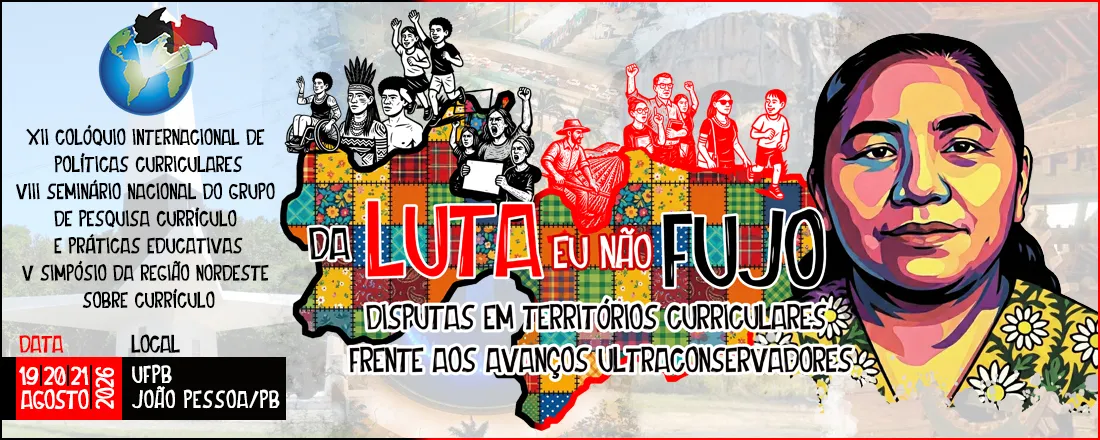
It is with joy and ethical-political commitment that we address you to invite you to XII International Colloquium on Curriculum Policies, made in conjunction with VIII National Seminar of the Research Group on Curriculum and Educational Practices and the V Symposium of the Northeast Region on Curriculum, which will take place on August 19, 20 and 21, 2026, at the Federal University of Paraíba, in João Pessoa.
At the easternmost point of the Americas, we will meet at a time marked by the advance of ultraconservative projects that directly affect public education and the ways of producing curriculum. This advance has a transnational character and is expressed in a particularly visible way in South America, where ultraconservative projects already govern or dispute hegemony in a significant part of the countries of the continent, stressing public policies, social rights and educational agendas. Similar dynamics can be observed in different countries in Europe, with the strengthening of radical right-wing forces in governments and parliaments, as well as in other regions of the world, where authoritarian, moralizing, and anti-democratic discourses have been gaining centrality. By focusing on education, these movements produce direct effects on curricula, reconfiguring disputes for meanings and repositioning the school and the university as strategic fields of these political disputes.
It is in this context that we have chosen as the theme of this edition "I DON''''T RUN AWAY FROM THE STRUGGLE: DISPUTES IN CURRICULAR TERRITORIES IN THE FACE OF ULTRACONSERVATIVE ADVANCES", taking as a starting point the statement of Margarida Maria Alves: "I don''''t run away from the fight. It''''s better to die in the fight than to starve". Margarida''''s speech is not taken as a metaphor, but as an ethical-aesthetic-political affirmation that leads us to understand the curriculum as a territory of struggle, crossed by disputes between different projects of society. It is from this ethical-political horizon that we organize the debates in conferences, round tables, thematic panels and Working Groups, composing a program focused on the analysis of ongoing curricular policies. By focusing on ultraconservative advances, we invite you to reflect on the projects of society in dispute and on the curricula that produce, or try to contain, possible worlds, reaffirming our commitment to a public education crossed by the memory of popular struggles in defense of democracy.
By honoring Margarida Maria Alves, we reaffirm the centrality of the struggles waged in territories that take place beyond geographical boundaries, in relationships, ways of life and in the collective experiences of the countryside, forests, waters and other social spaces. These are territories historically crossed by violence, expropriation, and silencing, which affect traditional populations and communities, such as: family farmers, indigenous peoples, quilombolas, riverside dwellers, fishermen, and extractivists, but also other groups whose existence is systematically disallowed, such as terreiro populations, LGBTQIAPN+ people, and black people, among many others. Even so, it is in these territories that forms of collective organization, production of knowledge and educational projects committed to social justice are affirmed.
It is from this understanding that Margarida''''s trajectory inspires the understanding that curricular disputes do not only take place in official documents or in school institutions, but also in the formative experiences that emerge from popular struggles, work, land, water, forests and community lives. Thus, the curriculum is understood as a territory of dispute, crossed by antagonisms, negotiations and articulations of meanings that produce effects on schools, universities, teacher training and the lives that are inscribed in them. In the face of attempts to standardize, control and silence difference, we invite researchers, teachers, students and other education professionals to join this debate, reflecting on the curricular policies in progress, their impacts and their possibilities of rearticulation.
By holding this Colloquium, we reaffirm the Northeast as a political-epistemic space for the production of knowledge, situated thinking and collective confrontation with the offensives that threaten public education and democracy. It is from this collective, political and territorial commitment that this meeting becomes possible.
On behalf of the Organizing Committee, as well as the organizing and supporting institutions, we welcome all participants, hoping that this Colloquium will constitute a space for qualified meeting, dialogue and collective production. We thank the Scientific Committee, the reviewers ad hoc and collaborating institutions, whose work made this event possible.
More than an academic meeting, this Colloquium asserts itself as a political gesture: we don''''t run away from the fight, because it is in it that the curriculum is produced, disputed and reinvented.
João Pessoa, Paraíba, Brazil, August 2026.
With esteem,
Organizing Committee