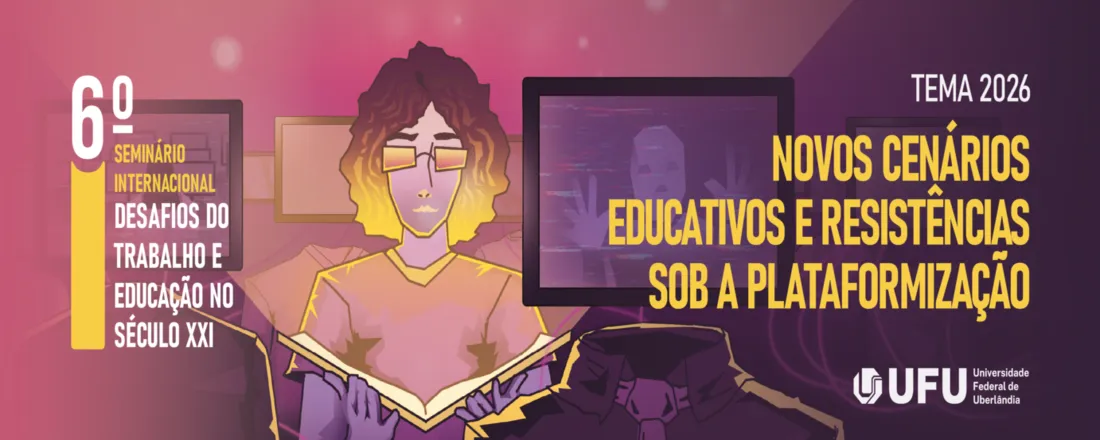
6º Seminário Internacional Desafios do Trabalho e Educação no Século XXI: novos cenários educativos e resistências sob a plataformização
Universidade Federal de Uberlândia - Uberlândia - Minas Gerais - Brasil
With online streaming
6º Seminário Internacional Desafios do Trabalho e Educação no Século XXI: novos cenários educativos e resistências sob a plataformização.
The 6th International Seminar on Challenges of Work and Education in the XXI Century is an interdisciplinary, interinstitutional and international academic event organized by a network of research groups from Graduate Programs, namely: Graduate Program in Education (PPGED/UFU), Graduate Program in Social Sciences (PPGCS/UFU), Graduate Program in Basic Education (PPGPEDU/UFU – Pontal Campus), Graduate Program in Geography of Pontal (PPGEP/UFU), Graduate Program in Professional Education at the University of Uberaba (PPGEP/UNIUBE), the Graduate Program in Education at the Federal University of Jataí (PPGE/UFJ), Graduate Program in Geography at the Federal University of Catalão (PPGEO/UFCAT) and the Graduate Program in Professional and Technological Education at the Federal Institute of Triângulo Mineiro (PPGEB/IFTM – Uberaba).
At the international level, the event establishes cooperation with the Faculty of Social Sciences and Humanities of the New University of Lisbon (FCSH/UNL – Portugal) and with the Instituto de Investigaciones en Ciencias de la Educación of the Universidad de Buenos Aires (UBA – Argentina).
Held since 2013, on a biennial basis, the seminar has established itself as a qualified space for academic debate. The event is based on the principle of inseparability between teaching, research and extension, promoting dialogue between university and society and contributing to the formulation of public educational policies.
Throughout its editions, the seminar has innovated in its proposals. Of note is the inclusion of the Film Festival, linked to the extension project "Political Education through the Seventh Art", which articulates cinema, education and citizenship.
Inscrições 2026
Modalidades de inscrição
Categoria
21/08/2026
10/09/2026
10/10/2026
22/10/2026
Professores(as) Ensino Superior / Pesquisadores
R$ 180
R$ 200
R$ 220
—
Estudantes de Pós-Graduação
R$ 100
R$ 120
R$ 140
—
Estudantes de Graduação
R$ 30
R$ 50
R$ 70
—
Professores(as) da Educação Básica
(Apresentar comprovante)
R$ 50
R$ 70
R$ 90
—
Demais Profissionais
R$ 80
R$ 100
R$ 120
—
Ouvintes
Passe o mouse para mais informações
Categoria destinada às pessoas que desejam apenas assistir às atividades do evento, como palestras, rodas de conversa, conferências e debates, sem obrigatoriedade de submissão ou apresentação de trabalho.
A certificação será concedida somente aos participantes devidamente inscritos e com a taxa de inscrição quitada.
20,00 até 17/08/2026
R$ 30
R$ 40
R$ 60
Mini-Cursos
(Vagas limitadas)
R$ 20
R$ 30
R$ 40
—
Nota de Empenho
O pagamento da inscrição poderá ser via empenho, no entanto, esse deverá ser individual. Qualquer documento adicional que a Faculdade/Universidade pagante exija, deverá ser solicitado pelo e-mail (semintertrabalho@gmail.com) e com prazo de atendimento de até 7 (sete) dias úteis. A inscrição por meio de “nota de empenho” deverá ser providenciada pelo participante junto à sua inscrição. O autor com trabalho aprovado deverá informar os seguintes dados à sua instituição:
Dados da empresa para emissão da Nota de Empenho:
FUNDACAO DE APOIO UNIVERSITARIO - FAU
CNPJ: 21.238.738/0001-61
Dados da Conta bancária:
Banco Sicoob
Agência: 4264
Conta bancária: 178.932-5
Após a finalização do processo enviar a nota para o e-mail da comissão: semintertrabalho@gmail.com
Palestrantes Confirmados
{{item.nome}}
{{item.nome}}
Atividades
{{item.titulo}}
{{item.horaInicio}}-{{item.horaFim}}
Lançamento de Livros
Tem um livro e quer compartilhar sua produção com a comunidade acadêmica?
O 6º Seminário Internacional abre espaço para autores e autoras apresentarem e divulgarem seus livros, promovendo um momento de encontro, diálogo e circulação da produção científica, acadêmica e cultural.
Quer participar do lançamento de livros durante o evento?
Preencha o formulário de manifestação de interesse e venha fazer parte deste espaço de troca e divulgação!
Após o preenchimento, a Comissão Organizadora entrará em contato com os (as) autores(as) para informar sobre o aceite e os detalhes da participação, incluindo local.
Monitorias
O Resultado será divulgado no dia 06/10/2026
Submissão de Artigos Completos - Regras e Template
Submissão dos Artigos Completos para publicação nos Anais
Somente para os Resumos aprovados - Período de submissão: 18/08/2026 a 10/10/2026
A submissão de artigos completos é destinada aos trabalhos previamente aprovados pela Comissão Científica na modalidade de resumo e que serão apresentados nos Grupos de Trabalho do 6º Seminário Internacional Desafios do Trabalho e Educação no Século XXI.
Serão aceitos artigos completos de trabalhos concluídos ou em andamento, desenvolvidos no âmbito da Iniciação Científica, da Graduação e da Pós-Graduação. Os artigos poderão ser submetidos nos idiomas português (Brasil e Portugal) e espanhol.
Normas para elaboração do artigo completo
O artigo deverá:
ter no mínimo 8 e no máximo 16 páginas;
apresentar objeto de análise, objetivos, referencial teórico, procedimentos metodológicos, resultados, conclusão ou considerações finais e referências;
seguir as normas da ABNT NBR 6023/2018, para as referências, e da ABNT NBR 10520/2023, para as citações no corpo do texto;
utilizar fonte Times New Roman, tamanho 12;
utilizar espaçamento entre linhas de 1,5;
utilizar papel A4, com margens de 3 cm à esquerda e superior e 2 cm à direita e inferior;
apresentar o corpo do texto justificado, com recuo de parágrafo de 1,25 cm;
seguir rigorosamente a formatação disponibilizada no template oficial do artigo completo.
O arquivo deverá ser submetido em formato .doc ou .docx. As figuras, quando utilizadas, deverão ser inseridas no corpo do trabalho como imagens e salvas em formato .jpeg.
Participação de orientador(a)
Nos trabalhos de estudantes de Graduação e Pós-Graduação, é obrigatória a indicação do(a) orientador(a) em campo próprio da plataforma. Não é necessário cadastrá-lo(a) como coautor(a), pois sua vinculação ao trabalho será realizada por meio desse campo específico, com inclusão automática como coautor(a) na publicação dos anais.
O limite de até 5 coautores(as) refere-se exclusivamente aos coautores cadastrados na submissão, não sendo o(a) orientador(a) contabilizado(a) nesse limite.
Limites de submissão
Cada participante poderá submeter:
até 2 trabalhos como autor(a);
até 2 trabalhos como coautor(a).
Cada trabalho poderá ter até 5 coautores(as) cadastrados na submissão e, quando se tratar de trabalho de estudante de Graduação ou Pós-Graduação, 1 orientador(a) indicado em campo próprio da plataforma.
Cada trabalho deverá ser submetido uma única vez, pelo(a) autor(a) responsável pela submissão, com a identificação de todos os coautores no ato da submissão.
A inclusão do ORCID é obrigatória, pelo menos para o(a) autor(a) responsável pela submissão.
Publicação nos Anais
A aprovação do resumo não garante automaticamente a publicação do trabalho nos anais. A publicação estará condicionada à submissão do artigo completo dentro do prazo estabelecido e ao atendimento rigoroso das normas editoriais do evento.
Os anais serão publicados com registro ISBN.
A Coordenação do Seminário reserva-se o direito de não publicar trabalhos que não estejam rigorosamente de acordo com as orientações estabelecidas.
Grupos de Trabalhos
GT1 – Platformization of Education and Reconfigurations of Teaching Work
The WG brings together research on the impacts of digitalization, platformization, and the incorporation of business technologies in educational processes and teaching work in Brazil and worldwide, with an emphasis on Latin America. It seeks to analyze the changes in the ways of teaching, evaluating, planning and managing pedagogical work mediated by digital platforms, artificial intelligence, monitoring systems and data technologies. It is interesting to discuss the relations between platform capitalism, commodification of education, algorithmic control and precariousness of teaching work, considering the implications for autonomy, training and working conditions. Studies on remote teaching, hybrid education, educational big data, edtechs, digital surveillance, and resistances built by teachers and educational collectives in the face of technocratic rationality in different Latin American and international realities will be welcomed.
PhD Professors Coordinators of WG 1:Adriana Omena Santos (UFU), Klivia de Cássia Silva Nunes (UFU), Soraya Franzoni Conde (UFSC), João Lucas Zanoni da Silva (UEMG), Alecilda Aparecida Alves Oliveira (UFSCar), Eduardo de Freitas Bernardes (UFU/ICHPO),Adriano Rodrigues De Souza De La Fuente (UFU) and Ari Raimann (UFJ), Arlindo José de Souza Jr (UFU)
GT1 modalities- Face-to-face - Uberlândia and Remote
GT2 – Teaching Work and Human Training in Basic Education
The WG proposes to debate the teaching work as a central activity in the processes of human formation, socialization of knowledge and constitution of historical subjects in Brazil and in the world, with emphasis on Latin America. It seeks to reflect on the tensions between emancipatory education projects and educational policies guided by the logic of the market and productive adaptation. It is interesting to discuss the historical, philosophical and sociological foundations of the teaching work, as well as the mediations between curriculum, pedagogical praxis, school culture and critical formation. Research that addresses integral education, pedagogical work, humanization, emancipation, educational praxis, critical curriculum and pedagogical experiences committed to social transformation and the defense of public schools in different Latin American contexts will be welcomed.
PhD Professors Coordinators<font face="Open Sans"> of GT2 :Juliene Silva Vasconcelos (IFTM - Uberaba Campus), Adriano Rodrigues de Souza de la Fuente (UFU), Glaucia Signorelli (UFU/ICHPO), Cílson Cesar Fagiani (Uniube), Camila Alberto Vicente de Oliveira (UFJ), Elizabeth Gottschalg Raimann (UFJ), Maria Aparecida Augusto Satto Vilela (UFU/ICHPO).
GT2 modalities: Face-to-face - Ituiutaba, Face-to-face - Uberlândia and Remote
GT3 – Higher Education, Teacher Training and Knowledge Production
The WG aims to discuss the transformations of higher education and their impacts on teacher training, research and knowledge production in Brazil and in the world, especially in Latin America. It seeks to analyze the policies of expansion, financing, evaluation and internationalization of higher education, considering their links with neoliberal reforms and the commodification of the university. It is interesting to understand the challenges faced by professors and researchers in the face of the intensification of academic work, scientific productivity and new forms of institutional regulation. Studies on initial and continuing teacher training, post-graduation, university teaching work, scientific policies, university autonomy and experiences of resistance in defense of the public, free, secular and socially referenced university in different national contexts will be welcomed.
<
div style="text-align: justify; ">PhD Professors<span style="font-family: "Open Sans"; font-size: 14px;"> of GT3 :Armindo Quillici Neto(UFU/ICHPO), Fernando Santos (UFJ), José Gonçalves Teixeira Junior (UFU/ICHPO).
GT3 modalities: Face-to-face - Uberlândia and Remote
GT4 –Working Conditions, Subjectivities and Teacher Illness
The WG proposes to discuss the relations between teaching work, health and subjectivity in the context of contemporary transformations of capitalism and neoliberal educational policies in Brazil and in the world, with an emphasis on Latin America. It seeks to analyze the processes of intensification, precariousness and flexibilization of work, as well as their physical, emotional and psychic impacts on teachers of basic and higher education. It is interesting to understand phenomena such as suffering, exhaustion, burnout, moral harassment, mental illness and loss of professional autonomy, articulating them with objective working conditions and forms of educational management. Research on the health of teaching workers, medicalization, care policies, collective coping strategies and experiences of resistance and solidarity in Latin American and international educational spaces will be welcomed.
PhD Professors Coordinators<font face="Open Sans"> of GT4 : Luzilene de Almeida Martiniano (UFU/FACES), Klivia de Cássia Silva Nunes (UFU), Eduardo de Freitas Bernardes (UFU/ICHPO), João Paulo de Sousa Areosa (IPS/Portugal).
GT4 modalities: Face-to-face - Ituiutaba, Face-to-face - Uberlândia and Remote
GT5 – Teaching Work from the Perspective of Gender and Race/Ethnicity
The WG aims to discuss the teaching work from the social relations of gender, race/ethnicity and class in Brazil and in the world, especially considering the structural inequalities present in Latin America. It seeks to analyze the processes of feminization of teaching, sexual and racial division of labor, institutional discrimination, violence and inequalities in the professional trajectories of teachers. It is interesting to understand how racism, sexism and other forms of oppression are articulated with educational policies and contemporary transformations of work. Studies on intersectionality, diversity, ethnic-racial relations, anti-racist education, feminisms, reproductive work, care, teacher identity, and collective experiences of struggle and resistance in educational spaces in comparative and Latin American perspectives will be welcomed.
PhD Professors Coordinators<font face="Open Sans"> of GT5: Maria Rita Nascimento Pereira (IFTM), Soraia Veloso Cintra (UFU/PONTAL), Antonio Carlos Lopes Petean(UFU).
GT5 modalities: Face-to-face - Uberlândia and Remote
GT6 – Teacher Unionism and Resistance Movements in Education
The WG proposes to reflect on the forms of collective organization and resistance built by teachers in the face of neoliberal reforms, the precariousness of work and the processes of dismantling public education in Brazil and in the world, with an emphasis on Latin America. It seeks to discuss the role of unions, social movements, teacher collectives and student organizations in the struggles in defense of public schools, professional valorization and social rights. It is interested in analyzing historical and contemporary experiences of mobilization, strike, political action and the construction of counter-hegemonic alternatives in the educational field. Studies on teacher unionism, work organization, class consciousness, political participation, criminalization of social movements, and strategies of resistance and solidarity in different Latin American countries and international contexts will be welcomed.
PhD Professors of GT6: Robson Luiz de França(UFU), Eliane Soares (UFU) and Rosianie Aparecida Oliveira da Silva (UFU/ICHPO)
GT6 modalities: Face-to-face - Uberlândia and Remote
GT7 – Education and Changes in the World of Work
The WG aims to discuss the relations between education and contemporary transformations in the world of work in Brazil and in the world, especially in Latin America, considering the impacts of productive restructuring, automation, financialization and new technologies on training processes. It seeks to analyze the disputes around training for work, professional qualification policies and conceptions of education linked to the demands of capital. It is interesting to understand how changes in the relations of production affect the school, the curriculum, the working youth and human formation. Studies on work and education, professional education, youth, unemployment, uberization, industry 4.0, socio-emotional skills and educational experiences aimed at the emancipation of workers from a Latin American and international perspective will be welcomed.
PhD Professors Coordinators<font face="Open Sans">> of GT7: Fernando Santos (UFJ), Sérgio Paulo Morais ( UFU) and Rosianie Aparecida Oliveira da Silva (UFU/ICHPO) and María
Mercedes Palumbo (UNLu/UBA).
GT7 modalities: In-Person - Uberlândia and Remote
GT8 - Educational Policies under Neoliberalism - Managerialism
The WG proposes to analyze contemporary educational policies in the context of the neoliberal offensive and the expansion of managerialism in Brazil and Latin America. It seeks to discuss educational reforms, privatization, accountability, large-scale evaluation, regulation and control mechanisms over school management and teaching work. It is interesting to understand the impacts of these policies on pedagogical autonomy, the curriculum, the financing of education, the intensification of teaching work and the right to public education. Theoretical and empirical studies on educational management, performative culture, meritocracy, international organizations, commodification of education, conservatism, school militarization and experiences of resistance and defense of democratic public schools will be welcomed.
Professors Coordinators of WG8: Fabiane Santana Previtali (UFU), Rosianie Aparecida Oliveira da Silva (UFU/ICHPO), Camila Alberto Vicente de Oliveira (UFJ), Ari Raimann (UFJ), Caio Sgarbi Antunes (UFG)
GT8 modalities: Presencial - Ituiutaba,Face-to-face - Uberlândia and Remote
>
EVENTO • MINICURSOS
MINICURSOS
Conhecimento crítico, formação e diálogo em diferentes perspectivas.
Todos os minicursos possuem carga horária de
4 horas e vagas limitadas.
Klívia Nunes (Campus Uberlândia) e Cida Satto (Campus Pontal)
O minicurso será ofertado nos campus Uberlândia e Ituiutaba, com o mesmo conteúdo e ministrado pelas mesmas docentes.
Profa. Dra. Adriana Omena Santos – Universidade Federal de Uberlândia (UFU)
Prof. Dr. Adriano Rodrigues de Souza de La Fuente – Universidade Federal de Uberlândia (UFU)
Profa. Dra. Alecilda Aparecida Alves Oliveira – Universidade Federal de Uberlândia (UFU)
Profa. Dra. Ana Elisabeth Santos Alves - Universidade Estadual do Sudoeste da Bahia (UESB)
Prof. Dr.Anderson Claytom Ferreira Brettas - Instituto Federal do Triângulo Mineiro (IFTM)
Profa. Dra. Andreia Cristina da Silva Almeida - Universidade Federal de Uberlândia (UFU)
Prof. Dr. Anselmo Alencar Colares - Universidade Federal do Oeste do Pará (Ufopa)
Prof. Dr. Antonio Carlos Lopes Petean - Universidade Federal de Uberlândia (UFU)
Prof. Dr. Arlindo José de Souza Júnior - Universidade Federal de Uberlândia (UFU)
Prof. Dr. Ari Raimann – Universidade Federal de Jataí (UFJ)
Prof. Dr. Armindo Quillici Neto – Universidade Federal de Uberlândia (UFU)
Prof. Dr. Caio Sgarbi Antunes - Universidade Federal de Goiás (UFG)
Profa. Dra. Camila Alberto Vicente de Oliveira – Universidade Federal de Jataí (UFJ)
Profa. Dra. Caridad Massón Sena – Instituto Cubano de Investigación Cultural Juan Marinello (Cuba)
Prof. Dr. Carlos Alberto Lucena - Universidade Federal de Uberlândia (UFU)
Profa. Dra. Cláudia Lúcia da Costa – Universidade Federal de Catalão (UFCAT)
Prof. Dr. Cláudio
Eduardo Félix dos Santos - Universidade Estadual do Sudoeste da Bahia (UESB)
Prof. Dr. Cílson Cesar Fagiani - Universidade de Uberaba (Uniube)
Profa. Dra. Cristiane Betanho - Universidade Federal de Uberlândia (UFU)
Prof. Dr. Douglas Gonsalves Fávero – Educação Básica de Uberlândia
Prof. Dr. Eduardo de Freitas Bernardes – Universidade Federal de Uberlândia (UFU)
Profa. Dra. Elenita Pinheiro de Queiroz Silva - Universidade Federal de Uberlândia (UFU)
Profa. Dra. Eliane Soares – Universidade Federal de Uberlândia (UFU)
Profa. Dra. Elizabeth Gotschalg Raimann – Universidade Federal de Jataí (UFJ)
Prof. Dr. Erlando da Silva Reses - Universidade de Brasília (Unb)
Profa. Dra. Fabiane Santana Previtali – Universidade Federal de Uberlândia (UFU)
Prof. Dr. Fábio Mansano de Mello -Universidade Estadual do Sudoeste da Bahia (UESB)
Prof. Dr. Fernando Santos – Universidade Federal de Jataí (UFJ)
Profa. Dra. Glaucia Signorelli – Universidade Federal de Uberlândia (UFU)
Profa. Dra. Jaquelina
Edith Noriega - Universidad
Nacional de San Luis
Prof. Dr. João Augusto Neves Pires -Escola Técnica Estadual de Hortolândia do Centro Paula Souza
Prof. Dr. João Lucas Zanoni da Silva – Universidade do Estado de Minas Gerais (UEMG)
Profa. Dra. Joelma Santos – Universidade Federal de Uberlândia (UFU)
Prof. Dr. José Claudinei Lombardi - Universidade de Campinas (UNICAMP)
Prof. Dr. José Gonçalves Teixeira Junior – Universidade Federal de Uberlândia (UFU)
Profa. Dra. Judith Naidorf -Instituto de Pesquisa Educacional da Universidade de Buenos Aires (IICE-UBA)
Profa. Dra. Juliene Silva Vasconcelos – Instituto Federal do Triângulo Mineiro (IFTM)
Profa. Dra. Klívia de Cássia Silva Nunes – Universidade Federal de Uberlândia (UFU)
Profa. Dra. Luzilene de Almeida Martiniano – Universidade Federal da Paraíba (UFPB)
Profa. Dra. Maria Aparecida Augusto Satto Vilela – Universidade Federal de Uberlândia (UFU)
Profa. Dra. María
Mercedes Palumbo - CONICET-Universidad Nacional de Luján, Universidad de Buenos
Aires
Profa Dra. Maria Rita Nascimento Pereira – Faculdade de Ciências Econômicas do Triângulo Mineiro (FCETM) / Instituto Federal de Goiás – Câmpus Anápolis (IFG)
Prof. Dr. Mario Borges Netto – Universidade Federal de Uberlândia (UFU)
Prof. Dr. Moacir de Freitas Júnior - Universidade Federal de Uberlândia (UFU)
Prof. Dr. Newton Duarte - Universidade Estadual Paulista Júlio de Mesquita Filho (UNESP)
Profa. Dra. Raquel Cordeiro Varela - Universidade Nova de Lisboa - Portugal
Prof. Dr. Raul Balbino - Universidade Federal de Uberlândia (UFU)
Prof. Dr. Ricardo Luiz Coltro Antunes - Universidade de Campinas (UNICAMP)
Prof. Dr. Roberto Della Santa Barros - Universidade de Aveiro - Portugal
Prof. Dr. Robson Luiz de França – Universidade Federal de Uberlândia (UFU)
Profa. Dra. Sálua
Cecílio - Universidade de Uberaba (Uniube)
Prof. Dr. Sergio Paulo Morais – Universidade Federal de Uberlândia (UFU)
Profa. Dra. Soraia Veloso Cintra – Universidade Federal de Uberlândia (UFU)
Profa. Dra. Soraya Franzoni Conde – Universidade Federal de Santa Catarina (UFSC)
Prof. Dr. Túlio Barbosa - Universidade Federal de Uberlândia (UFU)
Universidade Federal de Uberlândia - Campus Santa Mônica e Campus Pontal
 Universidade Federal de Uberlândia - Uberlândia - Minas Gerais - Brasil
 With online streaming


