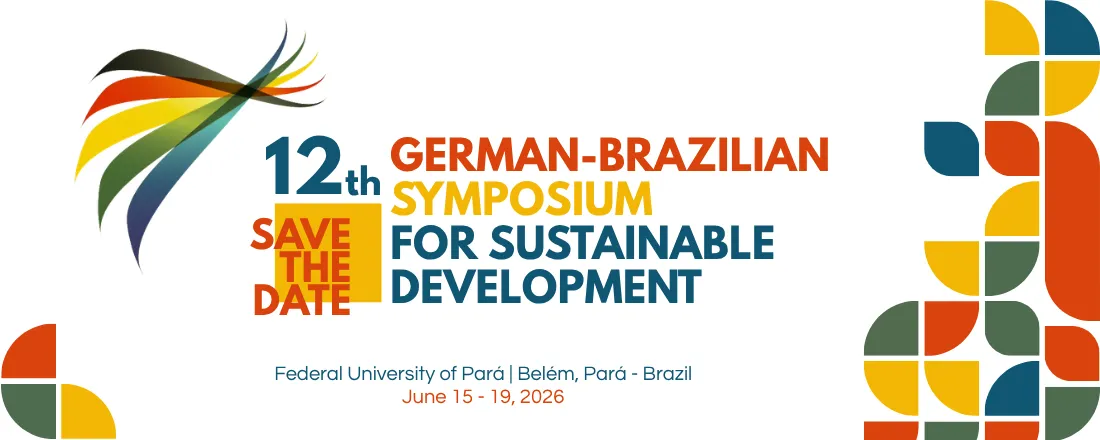
The 12th German-Brazilian Symposium for Sustainable Development

06/15/2026 - 06/19/2026 Universidade Federal do Pará - UFPA - Belém - Pará - Brazil | Brasil

The 12th German-Brazilian Symposium for Sustainable Development

Submission

{{areaSiteEvento.jsonObj.configuracaoSubmissao.dataInicioSubmissao}} - {{areaSiteEvento.jsonObj.configuracaoSubmissao.dataLimiteSubmissao}}

{{item.denominacao}}

{{areaSiteEvento.titulo}}

Organization

Funding Partners

Sponsors

Language

Check the portuguese version here.

About

The 12th German-Brazilian Symposium for Sustainable Development will be hosted by the Federal University of Pará (UFPA), under coordination of the Center for Advanced Studies of the Amazon (NAEA). The choice of Belém as a headquarters was the result of a decision made during the last symposium, held in March 2024 in the city of Tübingen (Germany). The event will be held mainly in person. However, there will be the possibility of remote participation by guest speakers (key speakers) in exceptional cases where face-to-face participation is not possible. The main lectures will be recorded and made available on NAEA’s YouTube channel. Since its first edition in 2003, the German-Brazilian Symposium has been conceived as an interdisciplinary event, with the aim of fostering and strengthening scientific cooperation between Brazil and Germany, aiming at the production of knowledge aimed at social transformation and sustainable development. Given the complexity of the challenges addressed, no restrictions were established regarding the areas of knowledge involved. However, researchers are expected to contribute not only from their specific areas but also with openness to interdisciplinary dialogue. The organization of the event favors this approach through a structure that combines thematic sessions (panels) with interdisciplinary integration tools, such as workshops, round tables and matchmaking sessions aimed at building new cooperation projects.

History

Since the early 1990s, a research partnership between Prof. Dr. Ernst Bayer (University of Tübingen) and Prof. Dr. Raimundo Damasceno (Universidade Federal Fluminense) has been in progress. After Prof. Bayer passed away in 2002, the efforts of this partnership took a new form  as a scientific conference, namely the 1st German-Brazilian Symposium. The first edition of this event took place in Tübingen, in 2003, addressing environmental issues from different scientific areas. Since then, the Symposiums have been held alternately every other year in universities from both countries. The following is a list of institutions that have hosted the event:

  • 2003 - University of Tübingen, Baden-Württemberg (BW), Germany
  • 2005 - UFSM, Santa Maria (RS), and UNISC, Santa Cruz do Sul (RS), Brazil
  • 2007 - University of Freiburg, BW, Germany
  • 2009 - UFPR, Curitiba (PR), Brazil
  • 2011 - University of Stuttgart, BW, Germany
  • 2013 - UFOPA, Santarém (PA), Brazil
  • 2015 - University of Heidelberg, BW, Germany
  • 2017 - PUCRS, Porto Alegre (RS), Brazil
  • 2019 - University of Hohenhein, BW, Germany
  • 2022 - UFF, Niteroi (RJ) and UFRJ (Rio de Janeiro (RJ), Brazil (the event was postponed one year because of the pandemic caused by the coronavírus)
  • 2024 - University of Tübingen, Baden-Württemberg (BW), Germany

The events are organized by a specific team from each university relying on the support from the Baden-Württembergisches Brasilien-Zentrum (BZ) der Universität Tübingen. In the year 2022, the Brasilien-Zentrum, after 20 years of existence, expanded, incorporating more Latin American countries, and was renamed as Baden-Württembergisches Brasilien- und Lateinamerika-Zentrum.

The aim of the symposium is to exchange scientific ideas between Brazilian and German partners in the area of sustainability. Different topics such as energy, water, soil, air, biodiversity, agriculture,silviculture and health have been addressed, in addition politics, economy, resource management and the future of cities. The symposium consists of keynote lectures and short-talks, as well as workshops, discussions,and technical visits

Key Speakers

Thematic sessions

The four thematic sessions reflect the breadth and interdisciplinarity of the symposium. Session one, sustainable agri-food systems for a resilient future, and two, strategies to strengthen resilience and sustainability in cancer research and drug development) are the result of consolidated cooperation between Brazilian and German researchers. Session three, development alternatives for a bioeconomy, and four, responsible resource extraction – mining – for a sustainable future, were included to broaden the event's focus on the social, environmental, and economic challenges of the Amazon.

Each thematic session has a binational team responsible for selecting guest speakers and establishing criteria for selecting submitted papers. Each panel will feature between 15 and 20 presentations, observing criteria of regional balance and gender equity.

Thematic session 01: Sustainable agri-food systems for a resilient future

Responsibles

Innovations in farming practices and supply chains are considered key drivers of the sustainable development of food systems. One way to balance the productivity of agri-food systems and the ecosystem health could be to integrate biodiversity and regenerative practices. However, empowering farmers through education and integrating their traditional knowledge will be crucial in achieving food sovereignty and improved responsiveness. One challenge and opportunity arising from increasing urbanisation is the development of adapted, resource efficient peri-urban agricultural systems and linking them with alternative food networks. At the same time, the role of policy, governance and regulation in shaping equitable and resilient agri-food systems will be addressed. Experts will share practical strategies and policy insights from diverse global and local contexts. We hope that participants will engage in a cross-sector dialogue to bridge the gap between science, practice and policymaking. A workshop will be organised to identify and co-develop a common research agenda with action points for future cooperation in the pursuit of resilient and sustainable food systems.


Confirmed Speakers
(Click on the icons to access the researcher's resume)

Thematic session 02: Strategies to strengthen resilience and sustainability in cancer research and drug development

Responsibles

Despite intense research efforts, we are facing a rapid increase in the number of cancer cases and cancer deaths worldwide. Successes in cancer screening and early detection mean that some tumors can be detected earlier and treated curatively, but depending on the tumor disease, 25-50% of all solid cancers are still diagnosed at an advanced, often metastatic stage. Despite scientific excellence, both resilience and sustainability are a challenge for new research approaches that combat this problem. iFIT (Cluster of Excellence (CoE) in “ImageGuided and Functionally Instructed Tumor Therapies”) addresses this challenge through a highly integrated and interconnected approach to academic cancer research and therapy development, combining three major research areas at the University of Tübingen (UT): A) Discovery of functional targets, academic drug development, and molecular therapies for tumors, B) Immunology and immunotherapies, and C) Multiparametric molecular and functional imaging. Another dimension of sustainability and resilience is a dynamic and rich scientific environment and a diverse social environment for students, researchers, and clinical scientists to enhance their individual scientific profile. Such approaches promise the development of new therapies and diagnostics for cancer and thus seek to significantly improve the prognosis for patients with advanced solid tumors.


Confirmed Speakers
(Click on the icons to access the researcher's resume)

Thematic Session 03: Development alternatives for a bioeconomy based on Amazonian socio-biodiversity

Responsibles

The Amazonian economy has some very distinctive characteristics. The most notable of these is the fact that, for centuries, it has been associated with extractive and/or agro-extractive production systems that are symbiotically integrated with the region's original biome. A consistent set of studies has shown that these systems have a high adaptive capacity and play a strategic role both in conserving the biome and in ensuring food and nutritional security for Amazonian populations. For this reason, it has the potential to sustain a significant portion of production and even the growth of a bioeconomy based on bioecology and biodiversity in the region. This “ancient” and ancestral bioeconomy, founded on Amazonian socio-biodiversity, is the result of a long and continuous process of development and innovation conducted endogenously by riverine communities, indigenous peoples, quilombolas, and other traditional peoples and communities. In this sense, it represents valuable knowledge about the paths that must be followed in pursuit of a regional development model based on the capacity for integration between economy and conservation.


Confirmed Speakers
(Click on the icons to access the researcher's resume)

Thematic session 04: Responsible resource extraction (mining) for a sustainable future — utopia or possibility?

Responsibles

Development models for a sustainable future must reduce material consumption, but at the same time depend on raw materials to implement the necessary technological changes. In the mining industry, there is a general belief that operational problems can be solved with financial resources and an effective scientific and technological approach. However, mining activities have an impact on the environment, society, and the economy: the three pillars of sustainability. Finding only technical or economic solutions to problems is not enough. Future challenges in a complex world also require a more socially and ecologically oriented approach. Sustainable mining for the future must be viewed holistically and also take ethical aspects into account. Local extraction of raw materials and their global supply chains shape the concerns and perceptions of employees and communities. Therefore, they influence the economic and political interests of various stakeholders. This is because mining operates in a field of tension between technical feasibility, economic profitability, legal protection, ecological and social responsibility, and human beliefs, behaviors, and expectations. In this session, the mining of the future will be examined and discussed from a responsible and sustainability-oriented perspective.


Confirmed Speakers
(Click on the icons to access the researcher's resume)

Workshops

The workshops are intended for discussions on cross-cutting issues of the symposium such as scientific cooperation, sustainability, bioeconomy, and scientific communication.

Workshop 1
Common research for future cooperation in the pursuit of resilient and sustainable food systems
Coordination:

Workshop 2
Outlook on future circular sustainability trends in bioeconomy
Coordination:

Workshop 3
Effective and responsible communication in science – How to engage properly and successfully?
Coordination:

Program (preliminary)

under construction

{{item.titulo}}
{{item.horaInicio}}-{{item.horaFim}}
Calendar

Registration

{{'Label_CodigoPromocionalAplicadoComSucesso' | translate}}
{{'Label_Presencial' | translate}} {{'Label_Online' | translate}} {{'Label_PresencialEOnline' | translate}}

{{item.titulo}}

{{'Label_DoacaoAPartir' | translate}} {{item.valores[0].valor | currency:viewModel.evento.moeda}}

{{'Titulo_Gratis' |translate}} {{viewModel.configuracaoInscricaoEvento.descricaoEntradaGratis}}
{{entrada.valor | currency:viewModel.evento.moeda}} {{entrada.valor | currency:viewModel.evento.moeda}}  

{{entrada.valorComDesconto | currency:viewModel.evento.moeda}}

{{'Titulo_Ate' | translate}} {{entrada.validoAte |date: viewModel.evento.cultura.formatoData}}
{{'Label_APartirDe' | translate}} {{entrada.validoDe | date:viewModel.evento.cultura.formatoData}}
Calendar

{{'Titulo_NaoDisponivel' | translate}}

Accommodations in Belém

Belém offers a wide variety of accommodation options, which include hotels of different categories and price ranges, catering to various visitor profiles. In the central areas of the city - such as Nazaré, Umarizal, Batista Campos, Campina and Cidade Velha - there are 3 to 5 star hotels with good infrastructure and easy access to restaurants, services and cultural points. 

Below we present a non-exhaustive list of recommended hotels, with different categories and approximate daily rates. All are located in central regions of Belém and a relatively close distance from the Federal University of Pará (UFPA), venue of the event - which corresponds to about 20 to 40 minutes of travel, depending on traffic. 

The reservation and booking of accommodation are the responsibility of the participants, it is recommended to make the reservation in advance.


Scientific committee

Dra. Birgit Hoinle (Hohenheim University, Germany)

Prof. Dra. Vania Gomes Zuin Zeidler (Leuphana University)

Prof. Dra. Georgia Moutella Jordão (Pontífica Universidade Católica Rio de Janeiro, Brazil)

Prof. Dr. Stefan Laufer (University of Tübingen, Germany)

Prof. Dra. Claudiana Lameu (University São Paulo, Brazil)

Prof. Dr. Niels Câmara (University of São Paulo, Brazil)

Prof. Dr. Jaderson Costa da Costa (Federal University of Rio Grande do Sul, Brazil)

Prof. Dr. Martin Hasselmann (Hohenheim University, Germany)

Prof. Dr. Jochen Dürr (University of Bonn, Germany)

Prof. Dr. Danilo Fernandes (Federal University of Pará, Brazil)

Prof. Dra. Ima Célia Guimarães Viera (Museu Paraense Emílio Goeldi, Brazil)

Prof. Dr. Armin Mathis (Federal University of Pará, Brazil)

Prof. Dr. Matthias Schmidt (Berliner Hochschule für Technik, Germany)

Prof. Dr. Giorgio Francesco Cesare de Tomi (University of São Paulo, Brazil)

Organizing committee

Andréa Junqueira Dessoy Maciel (Baden-Württembergisches Brasilien - und Lateinamerika - Zentrum)

Prof. Dr. Armin Mathis (Federal University of Pará, Brazil)

Josilene Ferreira (Center for Advanced Amazonian Studies/Brazil)

Katja Hölldampf (Founder of TROKA, Brazil)

Manuela André (Center for Advanced Amazonian Studies/Brazil)

Dra. Maria da Paz (Center for Advanced Amazonian Studies/Brazil)

Dra. Martina Schulze (Baden-Württembergisches Brasilien - und Lateinamerika - Zentrum)

Title of the Area

{{viewModel.evento.titulo}}

{{viewModel.evento.responsavelEvento}}