 Faculdades EST - São Leopoldo - Rio Grande do Sul - Brasil
Brazil is a paradoxical country. At the same time that it is one of the ten largest economies of the world, it is also one of the most socially unequal countries on the planet. The country produces airplanes while thousands of people are still illiterate or do not have access to basic sanitation in their homes. Exuberant nature on the one hand and destruction and rampant pollution on the other. Excessive religion, especially Christianity, is intertwined with culture and politics on a daily basis, while at the same time an individualistic and violent culture predominates.
Christian preaching is at
the origin, development, and perpetuation of this paradoxical reality,
intertwined with the life of the country throughout 500 years of colonization.
Preaching, as part of the Eurocentric colonial project, forged the country we
now call Brazil, as well as all of Latin America, with the paradoxical
characteristics that constitute them. This preaching was marked by diversity of
form and content, whether through Roman Catholicism or popular and syncretic
Catholicism, Protestant movements, or, more recently, Pentecostalism.
Regardless of tradition, preaching permeates the socio-political and cultural
fabric, ethical and moral values, human relations, narratives, and imaginaries
of this country, and movements of resistance to colonialism also found voice
and expression.
This intense and diverse
preaching will find new impetus with the advent of Protestant sectors,
especially from the 19th century onwards, whether through immigration or
missionary movements. In the 20th century, two theological developments would
further impact the religious effervescence and diversity of this context: the
emergence of Pentecostalism with its different faces and varied expressions,
and the development of contextual theologies, especially Liberation Theology.
Beyond contextual theologies, reflection in academia today shows an interest in
decolonial thinking and dialogue with religious traditions that have been
invisible for centuries, such as indigenous and African-American religions. At
the same time, there is growing interest and a need to intensify the debate on
theology and environmental issues, as well as gender and violence issues.
When it comes to preaching,
the situation is somewhat complex. On the one hand, there is the strengthening
of morally conservative, emotionalist, and fundamentalist preaching and the
flourishing of new spiritual, affective, and communicative practices in the
pulpits and beyond them. On the other hand, there is a certain crisis of
contextual and politically engaged preaching, the fragmentation of discourses,
and the erosion of public trust in religious institutions. The various forms of
Pentecostalism present in the Brazilian context, which are growing rapidly and
gaining influence, reflect much of this theological, cultural, and political
complexity, especially through their preaching. With due regard for the
differences, similar developments can be seen in other contexts in the global
south and, similarly, in part of the Nordic context, something that demands
reflection and investigation by homiletic science.
In the wake of these
reflections, the proposal for the 2026 Societas Homiletica Conference—to be
held for the first time in Brazil and South America—is to reflect especially on
the Pentecostalisms of the global south, and specifically of Brazil, on their
diversity and their impact on homiletics and preaching. Pentecostal preaching
is not a homogeneous and standardized block. For this reason, the intention is
to reflect on the diversity of Pentecostal preaching itself, but also on how
Pentecostal homiletics is influenced by the many voices of Christian preaching
and how it impacts and diversifies homiletics in the most diverse global
contexts. The aim is thus to deepen our understanding of how the Holy Spirit
moves in the polyphony of multiple voices, styles, aesthetics, and contexts of
contemporary preaching.
Reflecting on homiletics
from the perspective of Pentecostal preaching and its diversity implies
considering the many narratives that arise from this practice, as well as
thinking about Pentecostal preaching itself as strongly constructed
narratively, whether it be biblical narratives, personal and community
narratives in the form of testimony, or the narrative of the Spirit's action in
transforming lives and changing the socio-political and environmental context.
Last but not least,
reflecting on Pentecostal preaching and the Brazilian context means reflecting
on the transformations that Christian preaching has brought about, both on a
personal and community level, as well as contextually and globally. All of this
is of great interest to Societas Homiletica. Throughout its biennial
conferences, Societas Homiletica has brought together scholars of preaching
from different parts of the world to think deeply and sensitively about the
homiletic challenges of our time. Its participants are convinced that preaching
brings about change and express a continuous effort to articulate the homiletic
tradition with contemporary urgencies.
Based on this historical,
contextual, and thematic overview, we propose as the theme for the 2026
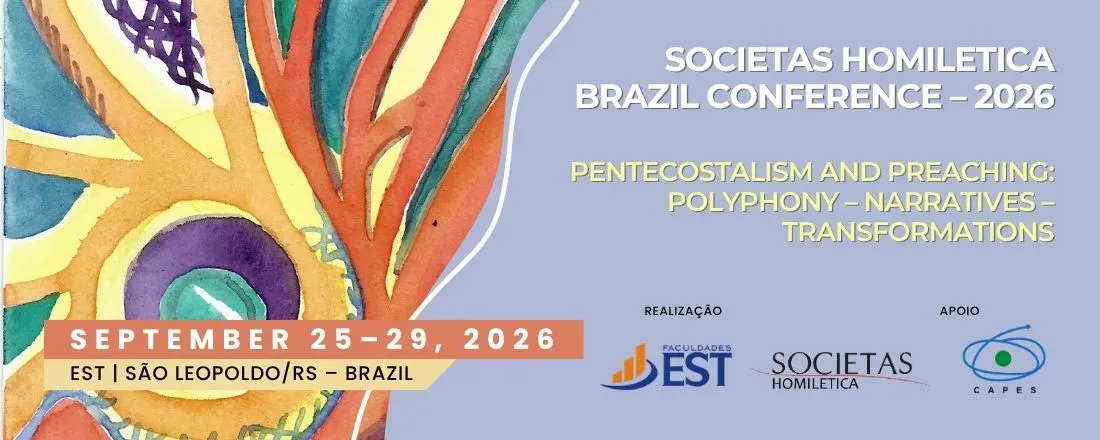
Societas Homiletica conference in São Leopoldo, the theme Pentecostalisms
and Preaching: polyphony – narratives – transformations.
We have structured this
theme around the following topics:
1. Discerning the Spirit
in homiletic diversity and polyphony: In different traditions,
epistemologies, hermeneutics, styles, and languages, the Holy Spirit blows
where it wills. How can homiletic science exercise spiritual discernment in the
face of the plurality of voices that emerge in Christian communities? How can
we also discern the forgotten and silenced voices, historically marked by
exclusion, and perceive the voices that come from the margins: women,
indigenous peoples, Afro-descendants, LGBTQIA+ people, among others? How can we
listen to and welcome these voices as expressions of the Spirit?
2. Pentecostalisms,
narratives, and emerging spiritualities: The strength of the Pentecostal
movement and its global and local variants has produced new homiletic models,
incorporating experiences, emotions, the body, as well as individual and
community narratives and testimonies. What can we learn from these practices in
terms of presence, affection, performativity, and listening to the Spirit? What
new homiletic methodologies are emerging? The digitization of faith and the
culture of social media are also profoundly changing the ways of preaching and
listening. How does the Spirit communicate in these media spaces? How can we
incorporate them into the practice and teaching of homiletics?
3. Preaching, social transformation, and the voice of creation in times of violence, banality, and rupture: Times of sociopolitical and ecological collapse and climate crisis, such as those faced by Brazil and other countries, challenge us to think about the role of preaching, in its different formats, in social and political transformations. How can preaching become an echo of the earth and a channel for a spiritual cry that is broader than the human one? Also, in the face of wars, intolerance, structural injustices, and historical traumas, what is the place of preaching? What kind of preaching and how can it be, at the same time, prophetic denunciation and spiritual consolation? Finally, how does preaching transform the world?


