 Sistema Famasul - MS - Campo Grande - Mato Grosso do Sul - Brazil | Brasil
Where science and nature come together to preserve the future.
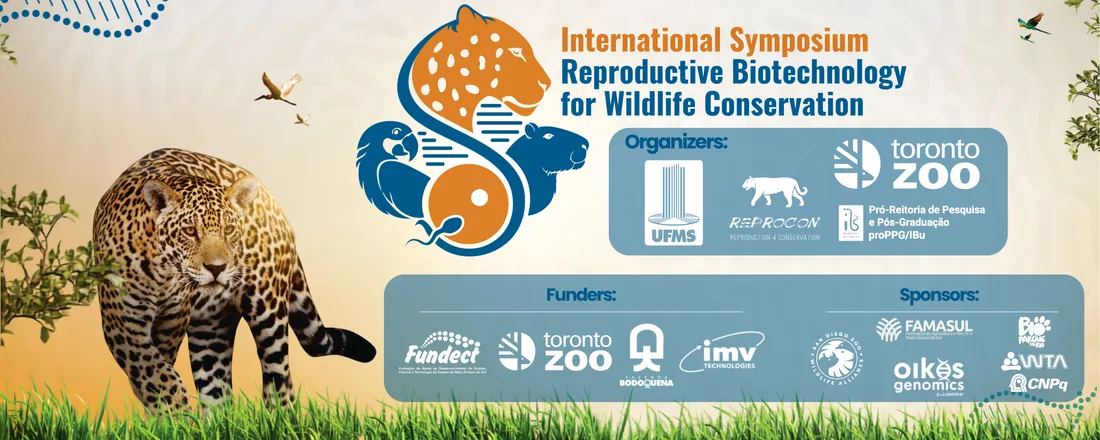
August 2026 | Campo Grande, MS, BrazilReprocon is proud to announce a new milestone in its trajectory. What began as a technical workshop focused on biotechnology and wildlife conservation has evolved into a global platform for strategic discussions.
In August 2026, we will host the 3rd International Symposium on Reproductive Biotechnologies Applied to Wildlife Conservation. This growth reflects the urgency and importance of our mission: to use cutting-edge science to ensure the survival of endangered species worldwide.
The symposium will be held in Campo Grande, MS, Brazil. Known as the "Capital of Biodiversity," the city serves as a strategic gateway to the Pantanal and is a global hub for environmental research and conservation.
We are currently finalizing the selection of a venue that meets the high technical standards of our international delegations. The official address and facilities will be announced soon. Stay tuned for updates!
Attending this symposium means joining a global community dedicated to conserving life through technology and applied science.
Known as the "Brown City," where wildlife coexists with the urban environment. Don't miss the Indigenous Nations Park for a sunset walk.
August is peak season for wildlife spotting. Photographic safaris offer a unique opportunity to see the majestic jaguar.
Brazil’s top ecotourism destination. Experience snorkeling in crystal-clear rivers and visit the Blue Lake Cave.
International: Fly into São Paulo (GRU/CGH), Brasília (BSB), or Rio (GIG). Direct flights to CGR take approx. 1h 30m.
Within Brazil: Direct connections via Latam, Gol, and Azul. 20 min from the main hotels.
| Start | Session Topic | Speaker & Affiliation |
|---|---|---|
| 07:30 | Accreditation | — |
| 08:30 | Opening Ceremony |  Dr. Thyara de Deco-Souza Dr. Thyara de Deco-Souza |
| 09:00 | From Living Collections to Living Legacies: The Role of Zoos and Zoo Associations in Conservation | Dolf Dejong Toronto Zoo |
| 09:40 | Biobanks as the Foundation of Biodiversity Genomics | Dr. Oliver Ryder IUCN / San Diego ZOO |
| 10:20 | Preservation of Gametes and Gonadal Tissues from Rare and Endangered Animal Species |  Dr. Pierre Comizzoli Dr. Pierre Comizzoli |
| 11:00 | The Pantanal Biobank | Dr. Pedro Nacib Jorge-Neto |
| 11:40 | Round Table |  Chair: Dr. Gabriela Mastromonaco Chair: Dr. Gabriela Mastromonaco |
| 12:10 | Lunch Break | — |
| 14:00 | The Relevance of Cytogenetics in Validating Samples within Germplasm Banks: The Example of Cervids | Dr. Maurício Barbanti |
| 14:40 | Reproductive Biotechnologies in the Conservation of Endangered Snakes | Dr. Beth Roberts |
| 15:20 | Poster Session #1 & Coffee Break | — |
| 16:00 | Reproductive Biotechnologies Applied to the Conservation of Neotropical Primates | Dr. Sheyla F. S. Domingues |
| 16:40 | Natural History Collections as Reference Biobanks: From Fixed Specimens to Living Cells for Taxonomy and Conservation Biotechnology | Dr. Sebastian Kirchhof Natural History Museum Abu Dhabi |
| 17:20 | Advancing Avian Reproductive Biotechnologies and Biobanking Strategies for Endangered Species Management |  Dr. Janaina Torres Carreira Dr. Janaina Torres Carreira |
| 18:00 | Round Table | Chair: Dr. Carla Bonetti Madelaire San Diego Zoo |
| 18:30 | Poster Session #2 | _ |
| 18:50 | Cocktail and Cultural Program | _ |
| Start | Session Topic | Speaker & Affiliation |
|---|---|---|
| 07:30 | Accreditation | — |
| 08:00 | 1000 Genomes: Mapping Chile's Biodiversity |  Dr. Carola Cañón Dr. Carola Cañón |
| 08:40 | Crafting a genomic strategy for biobanking and wildlife conservation | Dr. Matthew J. Miller Oikos Genomics |
| 09:20 | Oral Presentations - Best Abstracts I: Cellular immortalization of Blastocerus dichotomus fibroblasts: an alternative for the prolonged storage of biological material in biobanks | Janaína Mattos Lopes Torres |
| 09:35 | Oral Presentations - Best Abstracts II: Parental history and social context shape offspring survival in captive jaguars (Panthera onca) | Liandra M. Gaeth |
| 09:50 | Bison Cloning |  Dr. Leslie Antonio González Dr. Leslie Antonio González |
| 10:30 | iPSCs in the Conservation of Neotropical Animals | Dr. Fabiana Bressan |
| 11:10 | How to Implement Stem Cell Technologies for Conservation |  Dr. Ben Novak Dr. Ben Novak |
| 11:50 | Round Table | Chair: Dr. Marcia Ferraz |
| 12:20 | Poster Session #3 | |
| 12:40 | Lunch Break | — |
| 14:00 | Pharmacological Semen Collection and Cryobanking in the Andean Bear |  Dr. David Galindo Dr. David Galindo |
| 14:40 | South American Ichthyofauna Germplasm Bank | Dr. Danilo Streit Jr. |
| 15:20 | High-Security Biobank Specimen Receptacles & Biosafety | Technical Lecture |
| 15:35 | Oral Presentations - Best Abstract III: Embryonic developmental kinetics and uterine migration during early pregnancy in the brown brocket deer (Subulo gouazoubira) | Bianca Ferrari |
| 15:50 | Poster Session #4 & Coffee Break | — |
| 16:30 | Current Status of Animal Biobanking in Asia |  Dr. Boripat Siriaroonrat Dr. Boripat Siriaroonrat |
| 17:10 | Biobanking in Zoos: Building Programs from the Ground Up | Dr. Gabriela Mastromonaco |
| 17:50 | Round Table | Chair: Dr. Sebastian Kirchhof |
| 18:20 | Closing Remarks | Dr. Gediendson Araujo |
Top-tier experts for a world-class event!

{{item.nome}}
{{item.nome}}
{{'Label_DoacaoAPartir' | translate}} {{item.valores[0].valor | currency:viewModel.evento.moeda}}
{{item.descricao}}{{entrada.valorComDesconto | currency:viewModel.evento.moeda}}

Welcome to the official submission portal for the 3rd International Symposium on Reproductive Biotechnologies Applied to Wildlife Conservation. Our goal is to provide an effective platform for the communication of scientific discoveries, original ideas, practical challenges, and critical thinking in the field of biodiversity preservation.
Submissions must be categorized into one of the following areas:
We encourage a wide range of contributions. The following categories are accepted:
| Event | Deadline |
|---|---|
| Abstract Submission Deadline | May 30, 2026 |
| Scientific Committee Review | By June 15, 2026 |
| Deadline for Corrected Versions | By June 30, 2026 |
| Final Decisions & Oral Presentation Announcement | July 15, 2026 |
All approved abstracts will be published in the Conference Annals in a Peer-Reviewed International Scientific Journal as an Open Access publication, ensuring global visibility and impact for your research.
Submissions will be evaluated by an international scientific committee based on originality, methodological rigor, and relevance to wildlife conservation. The committee will select two outstanding works for Oral Presentation during the official symposium program.
For details on character limits, text structure, and citation style, please download the Author Guidelines document below.
{{areaSiteEvento.jsonObj.configuracaoSubmissao.dataInicioSubmissao}} - {{areaSiteEvento.jsonObj.configuracaoSubmissao.dataLimiteSubmissao}}
FAMASUL - R. Marcino dos Santos, 401 - Chácara Cachoeira, Campo Grande - MS, 79040-902