Description of the Thematic Axes
1. Educational Technologies and Innovations
This axis brings together research, experiences and theoretical reflections on the pedagogical use of digital technologies and on educational innovation processes in different teaching contexts. It covers studies related to digital culture, virtual learning environments, digital educational resources, artificial intelligence applied to education, mobile learning, open education, and technology-mediated teaching practices. It also includes investigations on active methodologies, educational design, production of digital teaching materials and experiences that contribute to pedagogical transformation and the improvement of teaching and learning processes.
2. Pedagogical Practices in Basic Education
This axis includes studies, experience reports and research on pedagogical practices developed in Early Childhood Education, Elementary Education and High School. It includes discussions on didactic planning, teaching methodologies, learning assessment, innovative pedagogical projects, and strategies that promote meaningful student learning. It also covers investigations on contemporary challenges of basic education, integration between theory and practice, integral training of students and pedagogical experiences that seek to strengthen the quality of education.
3. Special and Inclusive Education
This axis addresses research and experiences aimed at promoting inclusive education and meeting diversity in the educational context. It includes studies on public inclusion policies, inclusive pedagogical practices, educational accessibility, universal design for learning, assistive technologies and specialized educational service. It also includes reflections on the education of people with disabilities, autism spectrum disorders, developmental disorders and high abilities/giftedness, as well as institutional and pedagogical strategies aimed at guaranteeing the right to education for all.
4. Teacher Training and University Teaching
This axis brings together research on initial and continuing teacher training, teacher professional development and training practices at different levels of education. It covers discussions on teaching knowledge, professional identity, supervised internship, reflective practices and challenges of teacher training in the contemporary context. It also includes studies on university pedagogy, innovation in teaching in higher education, training processes in graduate studies and institutional strategies aimed at improving the quality of teaching and training of educators.
5. Curriculum and Educational Evaluation
This axis includes studies on curriculum organization, development and implementation of curriculum policies, as well as educational evaluation processes and instruments. It includes discussions on school and university curriculum, interdisciplinarity, learning assessment, institutional assessment, large-scale assessment and educational quality indicators. It also covers reflections on curricular reforms, national and international educational guidelines and evaluation practices that contribute to the improvement of educational processes.
6. Educational Management, Governance and Public Policies
This axis brings together research and reflections on educational management at different levels and modalities of education, addressing planning, organization and leadership in educational institutions. It includes studies on democratic management, institutional governance, educational public policies, education financing, strategic planning, and decision-making processes. It also includes investigations on school and university management, institutional evaluation, quality policies and strategies to strengthen educational management in contemporary contexts.
7. Higher Education and Internationalization in different contexts
This axis includes studies and experiences related to contemporary higher education, addressing topics such as access, permanence, inclusion, quality and expansion of higher education. It includes discussions on higher education policies, academic internationalization, student and faculty mobility, inter-institutional cooperation, research networks, and internationalization of the curriculum. It also covers reflections on processes of globalization of knowledge and experiences of internationalization in different institutional and regional contexts.
8. Vernacular Languages
This axis brings together studies focused on the teaching, learning and analysis of mother tongues, especially Portuguese, considering linguistic, literary, cultural and pedagogical dimensions. It covers research on reading, textual production, literacy, grammar teaching, literature and discursive practices. It also includes research on language policies, language teaching in basic and higher education, training of mother tongue teachers and innovative methodologies for language teaching.
9. Modern Foreign Languages
This axis includes research and experiences related to the teaching and learning of modern foreign languages in different educational contexts. It includes studies on language teaching methodologies, teacher training, interculturality, language policies and the use of digital technologies in language teaching. It also covers investigations on innovative pedagogical practices, collaborative learning, multilingual teaching and educational experiences aimed at intercultural communication.
10. Linguistics
This axis brings together theoretical and applied studies in the field of linguistics, contemplating investigations on language, discourse and communicative practices in different social and educational contexts. It covers research in areas such as applied linguistics, sociolinguistics, discourse analysis, pragmatics, translation studies, and linguistic variation. It also includes studies that articulate language and education, as well as investigations that contribute to the understanding of linguistic and communicative processes.
11. Science Teaching and Mathematics Education
This axis includes research and experiences aimed at teaching and learning in the areas of Natural Sciences and Mathematics at different levels and educational modalities. It includes studies related to teaching methodologies, scientific literacy, problem solving, scientific and mathematical modeling, development of scientific and logical thinking, as well as initial and continuing training processes for teachers in these areas. It also covers research on the use of digital technologies in the teaching of Science and Mathematics, scientific experimentation, investigative activities, production of teaching materials, innovative pedagogical practices and strategies that favor meaningful learning. It also includes reflections on contemporary challenges of science and mathematics education, including scientific dissemination, interdisciplinarity and promotion of scientific culture in the educational context.
12. Andragogy in non-formal (non-school) spacesThis
axis brings together studies and experiences related to the teaching and learning processes of young people and adults in non-formal contexts of education. It covers educational practices developed in social organizations, community institutions, cultural spaces, extension projects and professional training environments. It includes reflections on lifelong education, popular education, formative processes in diverse social contexts and pedagogical strategies aimed at human and professional development in non-school environments.
13. Educational Entrepreneurship in different contexts
This axis includes research and experiences related to entrepreneurship applied to education, addressing innovation in educational projects, development of entrepreneurial skills and creation of innovative educational solutions. It includes studies on entrepreneurial education, management of educational projects, culture of innovation, educational startups, and initiatives that seek to promote creativity, autonomy, and protagonism in educational processes.
14. Gamification and Play Pedagogy
This axis brings together studies and experiences related to the use of playful strategies and game elements in the teaching and learning process. It covers investigations on gamification, educational game design, game-based learning, and playful methodologies applied to education. It also includes reflections on student engagement, motivation for learning and the use of interactive resources that favor more dynamic and participatory educational processes.
15. Distance Education (EAD) and Hybrid
This axis includes studies, research, and experiences related to the modalities of distance education and hybrid teaching, considering their pedagogical, technological, and organizational foundations. It includes discussions on virtual learning environments, online pedagogical mediation, production of digital teaching materials, digital methodologies and assessment in virtual contexts. It also covers reflections on educational policies for distance learning, pedagogical innovation and the contemporary challenges of technology-mediated education.
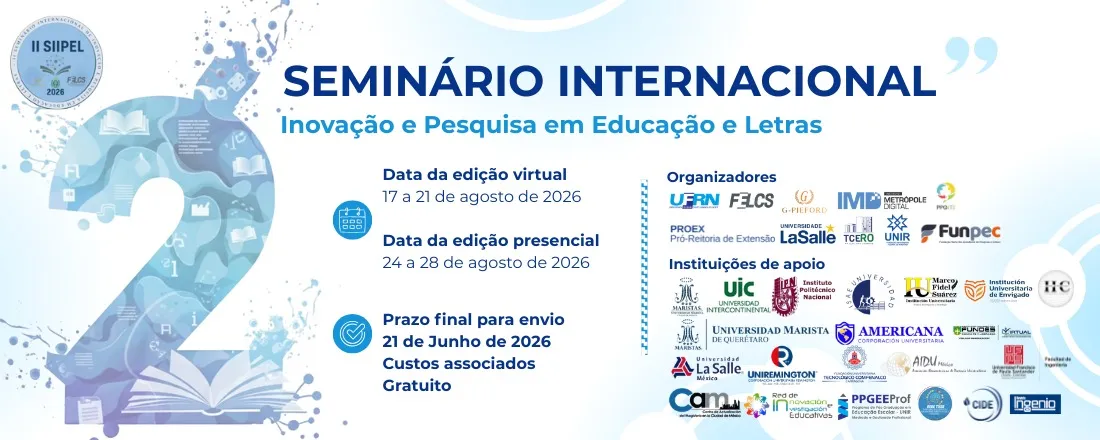
 UFRN - FELCS Currais Novos - Currais Novos - Rio Grande do Norte - Brasil
 With online streaming


