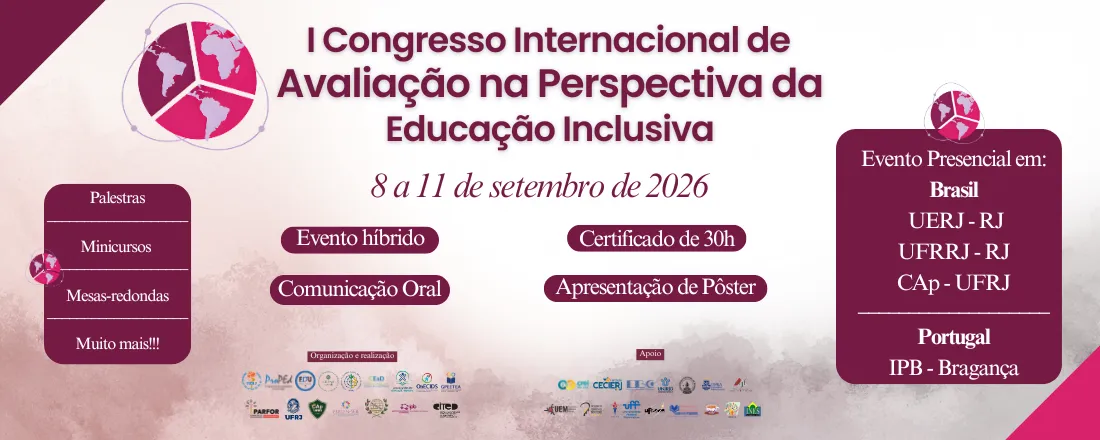
I Congresso Internacional de Avaliação na Perspectiva da Educação Inclusiva

I Congresso Internacional de Avaliação na Perspectiva da Educação Inclusiva

online Universidade do Estado do Rio de Janeiro - Rio de Janeiro - Rio de Janeiro - Brasil
presencial With online streaming

About the event

The I International Congress on Evaluation in the Perspective of Inclusive Education is a space for meeting, dialogue and collective construction of knowledge, dedicated to critical reflection on evaluation processes in the context of an education committed to equity, accessibility and social justice.

The event brings together researchers, teachers, students and education professionals from Brazil and abroad, interested in discussing possible ways to strengthen more humane, democratic and inclusive evaluation practices, which recognize and value the diversity of subjects, contexts and educational trajectories.

With a diversified program, which includes lectures, conferences, round tables, oral communications, experience reports, mini-courses and workshops, the congress promotes the articulation between research, training and pedagogical practice, encouraging the exchange of experiences and dialogue between different educational realities.

By placing evaluation at the center of the debate on inclusion, the congress proposes to rethink educational conceptions, methodologies and policies, seeking to contribute to the construction of more accessible, formative and emancipatory evaluation processes, capable of favoring access, participation, learning and permanence of all students.

The First International Congress on Evaluation in the Perspective of Inclusive Education was born from the commitment to an inclusive education that goes beyond discourse and materializes in practices, policies and research aimed at social transformation and the promotion of the right to education for all.

Schedule

{{item.titulo}}
{{item.horaInicio}}-{{item.horaFim}}
Calendar

Registration

{{'Label_CodigoPromocionalAplicadoComSucesso' | translate}}
{{'Label_Presencial' | translate}} {{'Label_Online' | translate}} {{'Label_PresencialEOnline' | translate}}

{{item.titulo}}

{{'Label_DoacaoAPartir' | translate}} {{item.valores[0].valor | currency:viewModel.evento.moeda}}

{{item.descricao}}
{{'Titulo_Gratis' |translate}} {{viewModel.configuracaoInscricaoEvento.descricaoEntradaGratis}}
{{entrada.valor | currency:viewModel.evento.moeda}} {{entrada.valor | currency:viewModel.evento.moeda}}  

{{entrada.valorComDesconto | currency:viewModel.evento.moeda}}

{{'Titulo_Ate' | translate}} {{entrada.validoAte |date: viewModel.evento.cultura.formatoData}}
{{'Label_APartirDe' | translate}} {{entrada.validoDe | date:viewModel.evento.cultura.formatoData}}
Calendar

{{'Titulo_NaoDisponivel' | translate}}

Submissions

{{areaSiteEvento.jsonObj.configuracaoSubmissao.dataInicioSubmissao}} - {{areaSiteEvento.jsonObj.configuracaoSubmissao.dataLimiteSubmissao}}

{{item.denominacao}}

{{areaSiteEvento.titulo}}

Template by modality

Access the template available for each writing modality. To edit it, it is necessary to download the file.

ORAL COMMUNICATION: Article/Research Completed - Access here
POSTER: Experience report - Access here

IMPORTANT!
Each participant may submit a maximum of 1 paper as an author and be in a maximum of 1 paper as a co-author, regardless of the type of writing/presentation.

The main author is responsible for submitting the work and including co-authors (everyone must pay for the registration).

Period Shipping: until May 24, 2026.

Each work will be classified as Approved, Approved with exception or Failed. Papers that are approved with reservations must be resubmitted within the stipulated deadline, with the changes requested by the evaluator in the Submissions Area.

  • Only papers in the "Oral Communication - Paper" modality with research results will be accepted completed;
  • Experience reports will be accepted in the "Poster - Experience Report" modality;
  • Derivative works from stricto sensu graduate research (master's or doctorate) must be co-signed by the advisor.
  • Inform ethical approval, when applicable;
  • Pay attention to the right to use images, indicating authorship, source and date, as well as authorization when necessary.


Thematic axes for submission of papers

AXIS 01 – Educational Evaluation and Inclusive Education
This axis brings together research that discusses conceptions, foundations and policies of educational evaluation from the perspective of inclusive education, covering all levels and modalities of education. It includes studies that analyze the relationship between evaluation, equity, educational justice and student permanence, as well as investigations on public policies and evaluation practices committed to the right to learning. It constitutes the theoretical support axis of the congress, welcoming reflections that problematize evaluation as a pedagogical practice guided by inclusion, participation and recognition of diversity.
<


p data-start="0" data-end="685">


AXIS 02 – Evaluation in Education Infant and Early Years of Elementary School

This axis brings together research aimed at the assessment of development and learning in childhood, considering the specificities of Early Childhood Education and the early years of Elementary School. It includes studies on inclusive evaluation practices, which value playfulness, accessibility and monitoring of the children's learning process. It also includes investigations that discuss the relationship between school and family in the evaluation processes, as well as pedagogical strategies that favor the participation and integral development of all children.


AXIS 03 – Evaluation in the Years Late Elementary and High

School

This axis brings together research that addresses the assessment of learning in the final years of Elementary School and High School, considering contexts marked by diversity. It includes studies on inclusive evaluation practices aimed at students with disabilities, Autism Spectrum Disorder (ASD) and High Abilities/Giftedness (HA/SD), as well as investigations that discuss the relationship between evaluation, curriculum and pedagogical flexibility. It also welcomes reflections on evaluation and school permanence in this stage of basic education.


AXIS 04 – Evaluation in the Education of Youth, Adults and Seniors (EJA/EJAI)

This axis brings together research that addresses the assessment of learning in Youth, Adult and Elderly Education, considering the specificities of these educational contexts. It includes studies on inclusive evaluation practices in intergenerational contexts, the permanence of students and the valorization of knowledge from experience and interrupted educational trajectories. It also includes investigations on evaluation related to literacy, popular education and evaluation practices in EJA integrated with professional education.


AXIS 05 – Assessment in Teaching Superior

This axis brings together research that analyzes evaluation practices in the context of higher education, with attention to inclusion, academic permanence, and student diversity. It covers studies on evaluation in face-to-face and distance courses, as well as investigations related to processes of internationalization of higher education. It also includes reflections on evaluation strategies that promote equity, accessibility and participation in the teaching and learning processes at this level of education.


AXIS 06 – Evaluation in Professional Education and Tecnológica

This axis brings together research that discusses evaluation in the field of Professional and Technological Education, including technical and technological courses. It includes studies on the assessment of professional skills and knowledge, inclusive assessment practices and processes that integrate theory, practice and assessment. It also hosts research that analyzes the challenges and possibilities of evaluation in contexts of technological innovation and training for the world of work.


AXIS 07 – Evaluation in Distance Education, Hybrid Learning and Virtual Environments

This axis brings together research that investigates evaluative practices in contexts of education mediated by digital technologies, including Distance Education (EAD), blended teaching, and virtual learning environments. It covers studies on digital accessibility, inclusive assessment on educational platforms and the use of technologies in monitoring learning. It also includes analyses of challenges, potentialities and innovations in the evaluation processes carried out in virtual and hybrid contexts.


<

div style="text-align: justify;">
AXIS 08 – Roboto Slab Teachers, Evaluation and Inclusive Education

<

div style="text-align: justify;">This axis brings together research that discusses the initial and continuing training of teachers for the development of inclusive evaluation practices. It includes studies on teaching knowledge, training processes and the role of evaluation in teacher training. It also includes investigations on internships, pedagogical practices and formative experiences that contribute to the professional development of teachers committed to inclusion and the right to learning of all students.


AXIS 09 – Methodologies, Instruments and Innovations in Educational Assessment

<

div style="text-align: justify;">This axis brings together research that addresses innovative methodologies, instruments and strategies in the field of educational evaluation. It includes studies on accessible evaluation methods, formative, diagnostic and procedural evaluation, as well as qualitative and participatory approaches. It also includes investigations that propose or analyze methodological innovations capable of expanding student participation and strengthening more inclusive and formative evaluation practices.


AXIS 10 – Large-Scale Evaluation: Assumptions and challenges
This axis brings together research that discusses evaluation in a broad way, problematizing its assumptions, purposes and implications in the face of the diversity of students. It includes studies on external evaluation policies, their instruments and uses, as well as their effects on educational processes and school trajectories. It also welcomes analyses on the challenges, limits, and ramifications of these evaluations, especially with regard to the tensions between standardization, equity, and educational justice.

PROGRAMMING - VISUAL MAP

Check out the schedule on a visual map here.

<span style="font-size: 14px;">Click below and get access to the full schedule!

 Schedule map


Organizing Committee


Prof. Dr. Suzanli Estef 

Universidade do Estado do Rio de Janeiro - UERJ | Universidade do Estado de Maringá - UEM


Prof. Taili Cristini Rosa

Universal Laboratory for Research on Accessibility in Evaluation - LUPAA/ProPEd-UERJ


Prof.ª Dr.ª Carla Cordeiro Marçal y Guthierrez

Universidade Federal Rural do Rio de Janeiro - UFRRJ


Prof. Dr. Carline Santos Borges

Universidade Federal Rural do Rio de Janeiro - UFRRJ


Prof. Dr. Thaís da Costa Motta

Colégio de Aplicação da Universidade Federal do Rio de Janeiro - CAp- UFRJ


Prof. Me. Thayná Marracho

Colégio de Aplicação da Universidade Federal do Rio de Janeiro - CAp- UFRJ


Prof.ª Me. Danielle Christina do Nascimento Oliveira

Colégio Pedro II - CP2


Prof. Dr. Carla  Isabel Pedroso de Lima

Polytechnic Institute of Bragança | Center for Transdisciplinary Research in Education and Development - IPB/CITeD


Prof. Dr. Paula Vaz

Polytechnic Institute of Bragança | Center for Transdisciplinary Research in Education and Development - IPB/CITeD


Prof. Dr. Ana Raquel Russo Prada

Polytechnic Institute of Bragança | Centre for Transdisciplinary Research in Education and Development - IPB/CITeD

Scientific Committee

Adriana da Silva Maria Pereira - UERJ
Adriana Patrício Delgado - UFRJ
Allan Rocha Damasceno - UNIRIO
Ana Raquel Russo Prada - IPB/CITeD
Annie Gomes Redig - UERJ
Carla Isabel Pedroso de Lima - IPB/CITeD
Carline Santos Borges - UFRRJ
Catia Crivelenti de Figueiredo Walter - UERJ
Cláudia Virgínia Albuquerque Prazim - UEPI
Cristina Angélica Aquino de Carvalho Mascaro - UERJ
Danielle Christina do Nascimento Oliveira - CPII
Elza da Conceição Mesquita - IPB
Fábio Garcia Bernardo - IBC
Flávia Faissal de Souza - UERJ
Flavia Wagner - UNISUL
Giseli Pereli de Moura Xavier - UFRJ
Graça Margarida Medeiros Teixeira e Santos - IPB
Izabel Cristina Silva Xavier - UFBA
Joyce da Silva Costa - FFP/UERJ
Juliana de Moraes Prata - UERJ
Karolini Galimberti Pattuzzo Breciane - UFES
Kelly Maia Cordeiro - UFRRJ
Leandra Souza Vieira - UFF/COLUNi
Leidiane dos Santos Aguiar Macambira - CPII
Luciana dos Santos Vieira Barcelos - UFF/CPII
Luís Castanheira - IPB
Luiz Antonio Gomes Senna - UERJ
Maíra Gomes de Souza da Rocha - UERJ
Mara Lúcia Reis Monteiro - UFF
Maria Cristina do Espírito Santo Martins - IPB
Maria Letícia Cautela de Almeida Machado - UERJ
Mariana Corrêa Pitanga de Oliveira - UFRRJ
Mariana Gonçalves Ferreira de Castro - UERJ
Mariana Lopes da Silva - IBC
Nádia Ferreira de Faria Braga - UFJF
Nathália Inácio de Souza - CPII
Neuzilene Ferreira Nascimento Burock - UERJ
Patricia Braun - CAp-UERJ
Paula Marisa Fortunato Vaz - IPB/CITeD
Pietro Matheus Bompet Fontoura Alves - UFBA
Raffaela Lupetina - IBC
Rejane de Oliveira Alves - UFBA
Renata Cardoso de Sá Ribeiro Razuck - UFRJ
Rita de Cássia Cruz Rodrigues - CPII
Rita Lee Lopes Vieira de Jesus - UFBA
Rosana Glat - UERJ
Salete Cecilia de Souza - UNISUL
Suélen Rodrigues de Freitas Costa - SEME IBITIRAMA / SEDU - ES
Tereza Maria Gomes Figuerêdo - UFBA
Thais da Costa Motta Rocha - CAp-UFRJ
Thatyana Machado Silva - UERJ
Thayane Azevedo Pereira de Souza - UERJ
Thayná Marracho Marques - CAp-UFRJ
Victor Barreto Neves de Oliveira - UERJ

Guests

{{item.nome}}

{{item.nome}}


Organization and Realization


Support


Event Location

{{viewModel.evento.titulo}}

{{viewModel.evento.responsavelEvento}}