 Escuela Normal Valle del Mezquital - Progreso de Obregón - Hgo. - México | México
 With online streaming
The FIPED International Pedagogy Forum – MEXICO will be held from October 21 to 23, 2026, in the city of Progreso de Obregón, in the State of Hidalgo, Mexico. The event, promoted by the collaboration between the Valle del Mezquital Normal School and the International Association for Research in Pedagogy in Pedagogy - AINPGP, will have the support of other Higher Education Institutions committed to the democratization of education.
The International Forum of Pedagogy - FIPED is an itinerant event, promoted by the International Association for Research in Undergraduate Pedagogy - AINPGP, created in 2008 at the State University of Rio Grande do Norte/Pau dos Ferros Campus, Brazil. FIPED is organized in two sessions: FIPED-Brazil and FIPED Exterior (outside the Brazil axis), which is held annually. In its history, FIPED has already had 15 editions in Brazil, held in 10 different states; 7 editions in Portugal, at the University of the Azores; and 10 editions of the FIPED Abroad session, which have toured seven countries: Portugal (2009), Costa Rica (2010), Mexico (2011), Honduras (2013), Cape Verde (2015), Spain (2020) and Argentina (2023). This information can be consulted at the following link: https://ainpgp.org/fipeds/.
FIPED-MEXICO proposes to critically discuss the place of research in graduation, with emphasis on the debate on knowledge and practices aimed at the initial training of research teachers. The central theme of the event will be "Educational research on intercultural teacher training and practice", with the aim of reaffirming the relevance of research and research training in the face of the challenges and possibilities of education in an intercultural society that aims to be democratic, critical and socially just.
In this edition of FIPED in Mexico, it is pertinent to reaffirm the principles that motivate its realization: diversity and interculturality. This is because the event was created with the perspective of becoming a space for the democratization of research and knowledge, both for undergraduate students and for academic campuses located on the margins of the academic circuit of urban centers. It is an educational policy that values historically marginalized subjects, territories and knowledge, making it possible for undergraduate students to enter the universe of research and to expand scientific production beyond traditional centers. Hence, undergraduate research is defended as an important field of study, recognising schools and universities as training centres for researchers and as pillars for the development of scientific knowledge. Thus, the FIPED has been constituted as an experience of struggle and resistance in favor of inclusion and diversity in scientific research.
In line with the trajectory of the event, FIPED - MEXICO aims at a broad debate on the place of research in the graduation and valorization of knowledge produced in the various territories of Latin America. Its realization in the State of Hidalgo-Mexico, in the region of the Mezquital Valley, an essentially indigenous territory, reaffirms the character of resistance and reinvention of the event, connecting indigenous culture with the global challenges of teacher training, academic research and educational technologies.
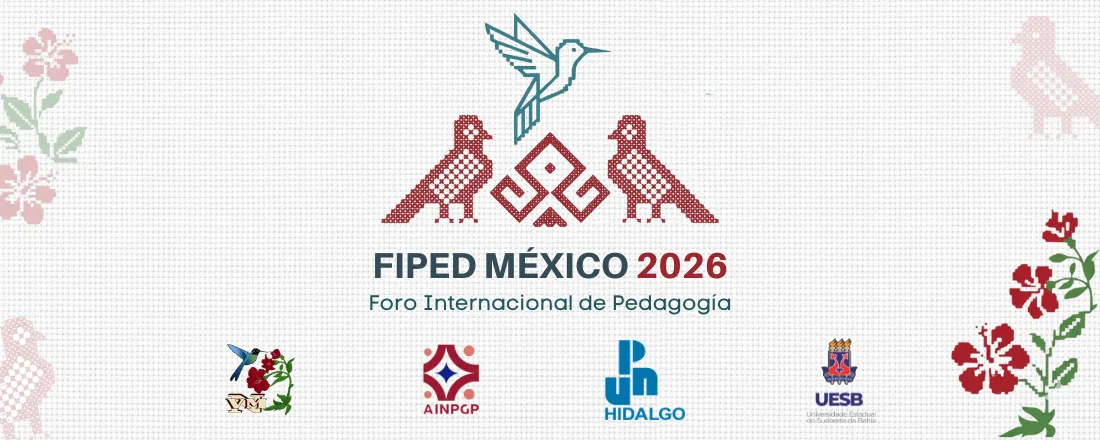
The image that best symbolizes this edition is inspired by the regional embroidery of the Otomi culture, speakers of Hñahñu. In this way, FIPED-MEXICO brings together elements that represent indigenous and Mexican resistance, a propitious scenario to reflect on the struggle for the right to education, culture and research.


