 Instituto Internacional de Física - Natal - Rio Grande do Norte - Brazil | Brasil
 With online streaming
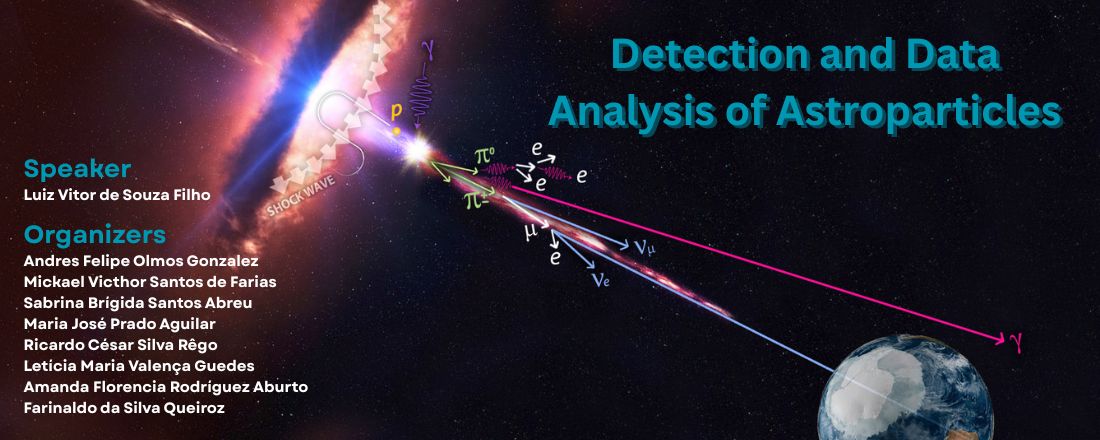
This short course offers a comprehensive introduction to the detection techniques and data analysis methods used in astroparticle physics, with a focus on ultra-high-energy cosmic rays (UHECRs) and very-high-energy gamma rays. Designed for advanced undergraduate and graduate students, the course consists of four one-hour lectures covering the physical principles, experimental techniques, and data interpretation strategies employed by leading observatories. The course aims to equip participants with the conceptual tools necessary to understand current and future experiments in astroparticle physics and to engage with the challenges of high-energy cosmic and gamma-ray data analysis.
The course will be taught by Prof. Dr. Luiz Vitor de Souza Filho. His research focuses on astroparticle physics, particularly in data analysis, instrumentation, air shower simulations, and astrophysical modeling. He is an active member of the Pierre Auger Observatory and the Cherenkov Telescope Array (CTA) collaborations.
The content of the four classes is described below.
Lecture 1 (07/28): Introduces the fundamental processes governing extensive air showers (EAS) generated by cosmic rays and gamma rays in the atmosphere. The session covers the physics of shower development, including electromagnetic and hadronic cascades, as well as key observables used in reconstruction.
Lecture 2 (07/29): Focuses on the detection of UHECRs with the Pierre Auger Observatory, detailing the hybrid detection strategy combining the Surface Detector (SD) array and Fluorescence Detectors (FD). Students will learn how the SD samples the shower front at ground level, while the FD records the longitudinal development of the EAS via atmospheric fluorescence.
Lecture 3 (07/30): Shifts to the detection of very-high-energy gamma rays with the Cherenkov Telescope Array Observatory (CTAO). The lecture presents the imaging atmospheric Cherenkov technique, telescope design, and the role of CTAO in multimessenger astrophysics.
Lecture 4 (07/31): This lecture is dedicated to data analysis and event reconstruction techniques. Topics include energy and arrival direction reconstruction, composition-sensitive observables, and statistical methods used to extract astrophysical information from detector data.
Location: IIP - Seminar Room 1 (First Floor)
Link to Google meet: meet.google.com/kvk-djaz-vmf
Time (changed to): 11am (Brasilia time)
Link to recorded classes on YouTube: https://www.youtube.com/playlist?list=PLqTLz9G2bGs0G5QQT6O-o4BA1_B2jt4uW
