 Este é um evento online
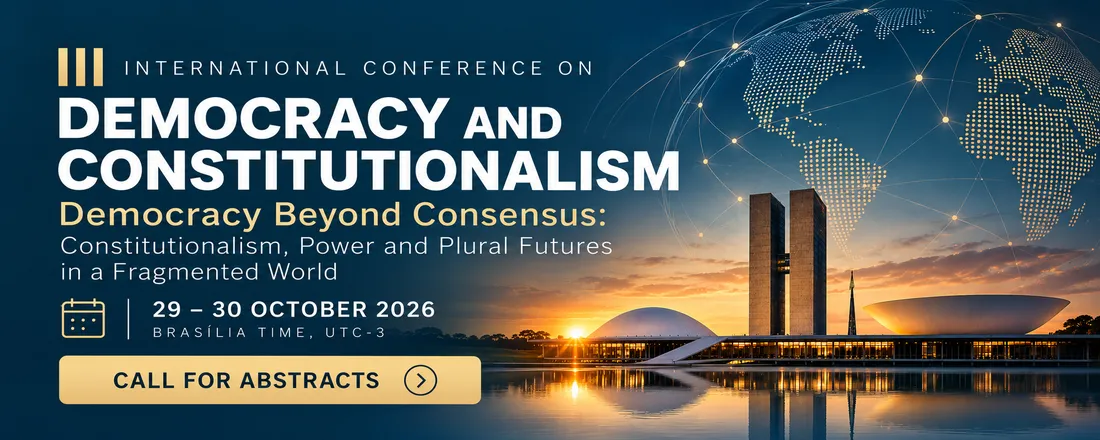
III INTERNATIONAL
CONFERENCE ON DEMOCRACY AND CONSTITUTIONALISM
Democracy Beyond
Consensus: Constitutionalism, Power and Plural Futures in a Fragmented World
29–30 October 2026
Brasília Time, UTC-3
International Conference and Call for Abstracts
1.
From an International Conference to a Research Network
The
International Conference on Democracy and Constitutionalism reaches its third
edition in 2026 as a continuing space for international academic dialogue on
the transformations affecting democracy, constitutionalism, the rule of law and
the institutional organisation of power.
The
Conference was established in 2024 from a concern that remains fundamental:
constitutional democracy cannot be adequately understood through the isolated
examination of constitutions, courts or electoral institutions. Democratic
stability depends upon interactions among political institutions, social
structures, technological transformations, economic inequalities, environmental
pressures, international relations and competing conceptions of legitimacy.
The
first edition, held on 24 and 25 September 2024, placed these problems within a
broad comparative framework. Its programme addressed authoritarianism,
democratic deterioration, populism, political fragmentation, the disruptive
effects of technology and social media, inequality, climate change,
sustainability and the relationship between development and democratic
institutions. The Conference explicitly sought to bring together scholars,
policymakers and civil society around the challenge of preserving and renewing
constitutional democracy under contemporary pressures.
Its
international composition was already significant. Scholars and practitioners
from Latin America, Europe, Asia, the Middle East and other regions examined
themes ranging from democratic self-defence and minority representation to
artificial intelligence, media freedom, climate change, participatory
democracy, international rule of law and different conceptions of democratic
participation. The resulting intellectual diversity established an important
premise that continues to guide the Conference: democracy and constitutionalism
must be discussed comparatively and across different legal, political and
cultural traditions.
The
second edition, held on 2 and 3 October 2025, advanced this agenda by moving
from the diagnosis of democratic pressures toward the governance of
interconnected risks. Under the theme “Constitutionalism under Polycrisis:
Reasonableness, Participation, and Systemic Risk Governance for Sustainable
Democracies,” the Conference examined how climate disruption, geopolitical
conflicts, energy and food insecurity, cyber risks and technological
transformations interact across jurisdictions and institutional domains.
The
internationalisation of the initiative also became more visible. The 2025
programme brought together 26 speakers from 14 countries, including
Brazil, Pakistan, Spain, Türkiye, China, Argentina, Chile, Egypt, Greece,
India, Paraguay and Poland, among others. Its discussions encompassed
multipolarity, deliberative democracy, human rights, climate constitutionalism,
artificial intelligence, digital democracy, Global South perspectives, minority
rights, corporate governance and multilevel governance.
This
development is more than numerical growth.
Across
its successive editions, the Conference has gradually constituted a network
of dialogue among researchers working from different constitutional
experiences, disciplinary traditions and geopolitical locations.
Participants are not invited merely to reproduce established categories within
different national settings. The purpose is to place those categories
themselves under comparative examination.
A
network perspective is especially important because contemporary constitutional
problems increasingly escape territorial and disciplinary boundaries. Decisions
concerning digital infrastructures, climate change, artificial intelligence,
migration, economic governance, geopolitical conflict or critical technologies
are produced through interactions among states, courts, international
organisations, corporations, research communities and transnational regulatory
structures.
Democratic
accountability, however, remains largely organised within national
constitutional systems.
The
resulting tension is increasingly significant: power operates through
networks while constitutional responsibility remains fragmented among
institutions and jurisdictions.
The
Conference therefore understands international academic cooperation not as an
accessory to constitutional scholarship, but as part of its methodology.
Comparative dialogue makes it possible to identify convergences without erasing
differences, to question the presumed universality of particular institutional
experiences and to examine alternative constitutional responses without
romanticising them.
The
progressive strengthening of the Conference consequently reflects the emergence
of a research community rather than simply the repetition of an annual academic
event.
The
2026 edition seeks to deepen this trajectory.
2.
The 2026 Question
Democracy
Beyond Consensus: Constitutionalism, Power and Plural Futures in a Fragmented
World
The
third edition begins from a different question.
The
previous Conferences examined threats to constitutional democracy and
subsequently the institutional capacity to govern systemic and interconnected
crises. The 2026 Conference moves one level deeper:
What
happens when disagreement concerns not only particular policies or
constitutional interpretations, but the meaning of democracy,
constitutionalism, sovereignty, rights and legitimate political authority
themselves?
Contemporary
international society is characterised simultaneously by geopolitical
multipolarity, technological transformation, environmental instability,
economic interdependence, social fragmentation and competing normative
projects.
The
traditional assumption that constitutional democracies would progressively
converge around a relatively stable institutional model has consequently become
increasingly difficult to sustain.
This
does not imply abandoning constitutional democracy.
It
requires examining its foundations more carefully.
The
relevant question is therefore no longer simply how democracy can survive
crises. It is also necessary to investigate which forms of democratic
authority can remain legitimate when political communities disagree about the
institutions, values and epistemic premises through which democracy itself is
defined.
The
title Democracy Beyond Consensus describes this analytical problem.
“Beyond
consensus” does not mean democracy without dialogue, rights or institutional
constraints. Nor does it imply equivalence between democratic and authoritarian
arrangements.
It
indicates instead that constitutional theory must confront persistent normative
disagreement and competing political experiences without presuming beforehand
that one institutional trajectory exhausts the possibilities of democratic
organisation.
The
2026 Conference therefore invites researchers to investigate democracy and
constitutionalism through six interconnected axes.
3.
THEMATIC AXES
AXIS
I
Democracy
after Consensus: Representation, Legitimacy and Political Pluralism
This
axis examines transformations in democratic legitimacy and political
representation.
Contributions
may address representative, participatory, deliberative, social, republican and
other traditions of democracy; political polarisation; populism; democratic
backsliding; constitutional identity; minority representation; political
parties; electoral systems; democratic self-defence; political participation
and the changing relationship between citizens and institutions.
Particular
attention is encouraged to research questioning whether disagreement itself
should be understood exclusively as a democratic pathology or also as a
permanent condition of plural constitutional societies.
AXIS
II
Constitutionalism
in a Multipolar World: Global South, Comparative Experiences and Competing
Normative Orders
This
axis examines constitutionalism within a changing distribution of international
power.
It
welcomes research concerning the Global South, BRICS+, Latin America, Africa,
Asia, Europe and other regions; South-South cooperation; constitutional
pluralism; international institutions; alternative conceptions of democracy;
decolonial approaches; comparative constitutionalism and reform of global
governance.
The
objective is neither to reproduce a single constitutional model as universally
applicable nor to romanticise political arrangements merely because they
originate outside dominant traditions.
Instead,
the axis encourages rigorous comparison of institutions, practices and
normative claims according to their historical contexts and their consequences
for participation, rights, accountability and political legitimacy.
AXIS
III
Artificial
Intelligence, Technology and Constitutional Power
Digital
technologies no longer operate exclusively as instruments subjected to
constitutional regulation. Increasingly, technological infrastructures
participate directly in the organisation and distribution of social and
political power.
This
axis invites research on artificial intelligence, algorithmic governance,
generative and agentic AI, automated public decision-making, platforms,
deepfakes, recommender systems, data governance, surveillance, digital
sovereignty, cybersecurity and technological infrastructures.
A
central question concerns whether technological systems increasingly exercise
functions historically associated with constitutional power by influencing
visibility, access to information, public discourse, administrative decisions
and opportunities for political participation.
AXIS
IV
Constitutionalism
under Permanent Risk: Climate, Conflict, Emergency and Future Generations
The
distinction between ordinary constitutional governance and exceptional crisis
governance is increasingly unstable.
Climate
emergencies, armed conflicts, pandemics, technological disruptions, cyber
threats, migration, disasters and economic shocks can generate prolonged forms
of emergency decision-making.
This
axis welcomes research concerning systemic risks, emergency powers, climate
constitutionalism, environmental justice, disaster governance, peace and
conflict, human security, intergenerational justice and institutional responses
to uncertainty.
Particular
attention may be given to the constitutional problem created when temporary
emergency arrangements progressively become ordinary techniques of governance.
AXIS
V
Fragmented
Authority: Courts, International Institutions, Corporations and Networks
Contemporary
governance increasingly involves authority distributed among actors that do not
fit easily within classical constitutional categories.
National
governments interact with constitutional and international courts, regulatory
agencies, international organisations, corporations, digital platforms,
financial institutions, scientific communities and transnational networks.
This
axis investigates accountability under conditions of fragmented authority.
Suggested
subjects include judicial review, constitutional jurisdiction, international
adjudication, multilevel governance, corporate power, transnational regulation,
human rights, global administrative structures and institutional
responsibility.
A
particularly relevant problem is the possibility that governance becomes
increasingly interconnected while responsibility becomes increasingly difficult
to identify.
AXIS
VI
Reimagining
Democratic Futures: Constitutional Innovation, Long-Term Governance and the
Global Commons
Democratic
institutions must increasingly make decisions whose consequences extend beyond
electoral cycles and, frequently, beyond territorial borders.
This
final axis invites contributions concerning future generations, constitutional
innovation, institutional experimentation, democratic foresight, global
commons, outer-space governance, critical infrastructures, biotechnology,
climate governance and new mechanisms of citizen participation.
It
also encourages a broader question:
Can
constitutional democracy develop institutions capable of representing
interests, persons and risks that are politically significant but
insufficiently represented by existing electoral mechanisms?
4.
CALL FOR ABSTRACTS
The
III International Conference on Democracy and Constitutionalism invites
scholars, researchers, professors, doctoral and master's candidates, legal
professionals, policymakers and members of research institutions to submit
proposals for presentation within one of the six thematic axes.
Proposals
should contribute to the international and comparative character of the
Conference and may adopt doctrinal, theoretical, empirical, interdisciplinary
or comparative methodologies.
Critical
approaches are particularly welcome when supported by clearly identifiable
theoretical or empirical foundations.
The
Conference encourages submissions that:
- compare constitutional or democratic experiences
across jurisdictions;
- connect
constitutional law with political science, international relations,
technology, environmental studies, economics or other relevant
disciplines;
- analyse experiences and theoretical contributions
originating in the Global South;
- question established categories or measurements
of democracy and constitutionalism;
- investigate emerging forms of public or private
power;
- identify institutional innovations capable of
strengthening democratic accountability.
Abstracts
should clearly indicate the research problem, objective, methodological
approach and principal argument or expected findings.
Suggested
abstract length: 300–500 words.
Languages: English, Portuguese or Spanish.
Presentations
may be delivered in any of these languages.
Each
accepted contribution will receive 15 minutes for presentation.
Every
sub-session will conclude with 15 minutes of collective discussion,
encouraging dialogue among speakers and participants rather than isolated
sequential presentations.
The
Scientific Committee may relocate a proposal to another thematic axis when this
improves thematic coherence.
III INTERNATIONAL CONFERENCE ON DEMOCRACY AND CONSTITUTIONALISM
Democracy Beyond Consensus: Constitutionalism, Power and Plural Futures in a Fragmented World
29–30 October 2026
Online International Conference
Brasília Time — UTC-3
DAY ONE
THURSDAY, 29 OCTOBER 2026
09:00–09:40
OPENING SESSION
III International Conference on Democracy and Constitutionalism
Institutional welcome and opening remarks.
Presentation of the Conference, its international network and the central theme of the 2026 edition:
Democracy Beyond Consensus: Constitutionalism, Power and Plural Futures in a Fragmented World
Opening participants:
Cássius Guimarães Chai
Sérgio Neira-Penã
Jędrzej Skrzypczak
Anju Gupta
09:40–09:50
Transition / Short Break
09:50–12:00
SESSION I
Constitutionalism in a Multipolar World: Participation, Responsibility and Global Commons
This session examines constitutionalism beyond the traditional state-centred model, connecting comparative constitutional experiences, public participation, international responsibility, fiscal governance, environmental protection, intergenerational justice and the governance of global commons.
Moderator: CARLA NOURA TEIXEIRA
09:50–10:10
Beyond Formal Rights: Fiscal Governance and the Search for Substantive Constitutionalism in Latin America and China
Maria Francesca Staiano
Discussion focus: Substantive constitutionalism, fiscal governance, human rights, political legitimacy and comparative perspectives between Latin America and China.
10:10–10:30
Public Participation, Prosecutorial Accountability and Human Rights: The People’s Supervisors System in China
Bo Yi
Discussion focus: Public participation, prosecutorial accountability, human rights protection and institutional experiences of democratic participation.
10:30–10:50
La responsabilidad de los Estados en medio del desorden internacional: en materia de derechos ambientales y pueblos indígenas
Krupskaya Rosa Luz Ugarte Boluarte
Discussion focus: International responsibility of States, environmental rights, Indigenous peoples and accountability under conditions of fragmented global governance.
10:50–11:10
Orbital Debris and the Democratic Representation of Future Generations
Francisco Campos da Costa
Discussion focus: Intergenerational justice, democratic representation, institutional foresight, outer-space governance and global commons.
11:10–11:50
COLLECTIVE DISCUSSION
Constitutional Responsibility Beyond Borders: Participation, Global South Perspectives and the Governance of Shared Futures
Suggested guiding questions:
How does constitutional responsibility operate when political and economic power exceeds national borders?
How can different institutional models of participation be compared without presupposing a single democratic template?
How should responsibility be distributed when constitutional harms are transnational or intergenerational?
What contributions can Global South experiences make to general constitutional theory?
Can fiscal governance, prosecutorial accountability, environmental responsibility and outer-space governance be understood through a common framework of fragmented authority?
11:50–12:00
SESSION SYNTHESIS
From State-Centred Constitutionalism to Networked Constitutional Responsibility
15:00–17:00
SESSION II
Democracy after Consensus: Representation, Participation and Constitutional Legitimacy
This session examines transformations in the foundations of democratic legitimacy, focusing on contested constitutional concepts, political participation, electoral representation, accessibility and the relationship between constitutional and international human rights standards.
Moderator: FURQAN AHMED
15:00–15:20
Separation of Powers as an Essentially Contested Concept: Between Constitutionalism and Democracy
Oscar Pérez de la Fuente
Discussion focus: Separation of powers, constitutionalism, democracy, judicial independence and the counter-majoritarian problem.
15:20–15:40
Cyberdemocracy and Accessibility: Equal Political Participation from a Feminist Disability Perspective
Reginaldo de Souza Vieira & Priscylla Alves Piucco
Discussion focus: Cyberdemocracy, equal political participation, accessibility, gender and the political inclusion of women with disabilities.
15:40–16:00
Candidaturas Independientes y Control de Convencionalidad en Brasil: el Tema 974 del STF a la Luz del Artículo 23 de la Convención Americana sobre Derechos Humanos
Luis Filipe Maia
Discussion focus: Independent candidacies, political rights, constitutional adjudication and conventionality control under the American Convention on Human Rights.
16:00–16:40
COLLECTIVE DISCUSSION
Representation Beyond Formality: Participation, Rights and Democratic Legitimacy
Suggested guiding questions:
Which institutions remain capable of legitimising political power under conditions of profound disagreement?
Is separation of powers a stable constitutional principle or a historically contested institutional arrangement?
How can democratic participation become substantively accessible rather than merely formally available?
To what extent can international human rights law reshape domestic electoral institutions?
What does democratic inclusion require beyond traditional political representation?
16:40–17:00
SESSION SYNTHESIS
Who Represents, Who Participates, Who Decides?
Concluding reflections on representation, accessibility, political rights and constitutional legitimacy.
DAY TWO
FRIDAY, 30 OCTOBER 2026
09:00–11:00
SESSION III
Artificial Intelligence, Algorithmic Power and Constitutional Authority
The final academic session examines the transformation of constitutional authority through artificial intelligence and algorithmic infrastructures.
Rather than approaching artificial intelligence solely as an object of regulation, the session asks whether technological systems increasingly participate in the production, distribution and exercise of political and normative power.
Moderator: VITOR HUGO SOUZA MORAES
09:00–09:20
When Design Becomes Authority: Artificial Intelligence, Depoliticisation and Democratic Legitimacy beyond Consensus
Sumeyye Nur Mete
Discussion focus: Algorithmic power, critical theory of technology, depoliticisation, digital constitutionalism and democratic legitimacy.
09:20–09:40
Democracy and the Rule of Law at the International Level: Artificial Intelligence
Sergio Peña-Neira
Discussion focus: Artificial intelligence, international rule of law, human rights and democratic governance beyond national jurisdictions.
09:40–10:00
Algorithmic Sovereignty and the Monopoly of Force: Lethal Autonomous Weapons Systems in a Fragmented Global Order
Carmelo Cattafi
Discussion focus: Algorithmic sovereignty, autonomous weapons systems, international humanitarian law, accountability and meaningful human control.
10:00–10:40
COLLECTIVE DISCUSSION
From AI Regulation to Algorithmic Constitutional Power
Suggested guiding questions:
When does technological design become an exercise of political authority?
Can constitutional legitimacy be preserved when significant decisions are delegated to algorithmic systems?
Who is accountable when AI-generated decisions operate across jurisdictions?
Does autonomous decision-making challenge the traditional constitutional monopoly over legitimate coercive force?
Should constitutional theory conceptualise algorithmic infrastructures as emerging sites of power?
10:40–11:00
CROSS-SESSION SYNTHESIS
Democracy Beyond Consensus: Constitutionalism, Power and Plural Futures
Connecting the three academic sessions:
Session I — Where does constitutional responsibility lie?
Fragmented authority, comparative constitutionalism, international responsibility and shared futures.
Session II — Who legitimately participates in and exercises political power?
Representation, political participation, accessibility and democratic legitimacy.
Session III — How is power itself being transformed?
Artificial intelligence, algorithmic authority, technological sovereignty and autonomous decision-making.
The three sessions converge around a common problem:
How can constitutional democracy remain legitimate when authority is simultaneously fragmented across jurisdictions, contested within political communities and increasingly mediated by technological systems?
11:00–12:00
CLOSING SESSION
III International Conference on Democracy and Constitutionalism
Closing reflections and institutional remarks.
The session will include:
synthesis of the principal discussions of the Conference;
reflections from the Conference coordinators and international partners;
strengthening of the International Conference on Democracy and Constitutionalism research network;
presentation of the publication project arising from the Conference;
information concerning the two edited volumes:
7.
A CONTINUING INTERNATIONAL RESEARCH AGENDA
The
III International Conference on Democracy and Constitutionalism should
therefore be understood as both an event and a continuing research environment.
Its
first edition asked how constitutional democracy could respond to contemporary
threats.
Its
second edition investigated how democratic institutions could govern
interconnected systemic risks.
Its
third edition asks a more fundamental question:
How
can constitutional democracy remain legitimate in a world characterised by
plural political experiences, fragmented authority, technological power,
systemic risks and competing understandings of global order?
The
progression may be summarised as:
2024
— Defending Constitutional Democracy
2025
— Governing Constitutional Democracy under Polycrisis
2026
— Rethinking Constitutional Democracy in a Fragmented and Multipolar World
The
Conference does not seek an artificial consensus among these perspectives.
Its
purpose is to create the conditions for rigorous disagreement, comparative
inquiry and sustained international cooperation.
The
strength of an international research network lies precisely in its capacity to
place different experiences into dialogue without suppressing their
differences.
As
the Conference enters its third edition, its central commitment remains
therefore unchanged but increasingly necessary: to understand constitutional
democracy not as a completed institutional formula, but as an ongoing problem
of rights, power, responsibility and legitimate collective self-government.
Publication Opportunity
Authors whose papers are presented at the III International Conference on Democracy and Constitutionalism will be invited to submit a complete manuscript of up to 7,000 words for consideration for publication. Manuscripts must be written in English or Spanish and follow APA 7th edition. Selected contributions will be organised into two edited volumes, one in English and one in Spanish. The deadline for submission of complete papers is 15 April 2027. Submission does not guarantee publication, and all manuscripts will be subject to scientific and editorial review.

