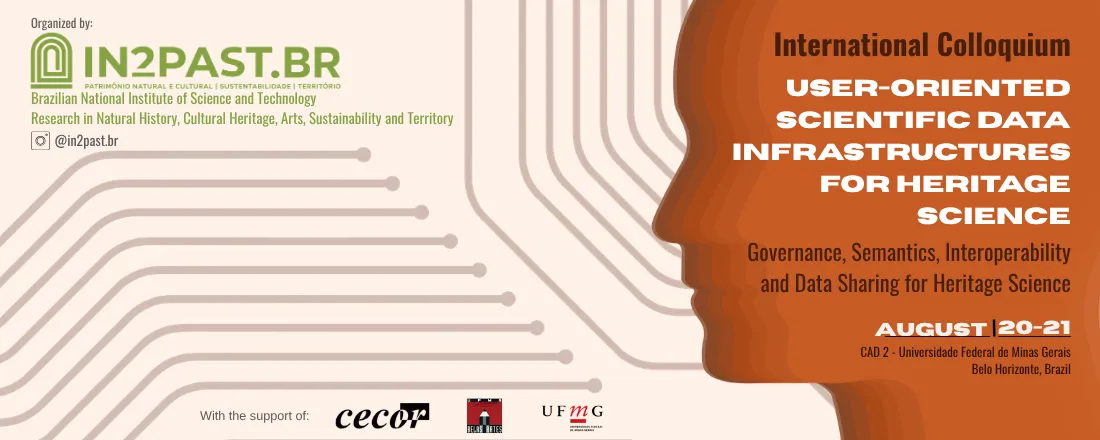
Colloquium User-Oriented Scientific Data Infrastructures for Heritage Science

Colloquium User-Oriented Scientific Data Infrastructures for Heritage Science

online Centro de Atividades Didáticas 2 (CAD 2) - Universidade Federal de Minas Gerais - Belo Horizonte - Minas Gerais - Brasil
presencial With online streaming

Essential Event Information

✓ Free registration required
✓ Hybrid event: in-person and online participation
✓ Event conducted in English
✓ Live online streaming with Portuguese subtitles for registered participants
✓ Digital certificate of participation available*


Event Dates and Hours

Day 1 — Thursday, 20 August 2026
8:30 AM–5:00 PM (Brasília Time — BRT, UTC−3)
Registration and badge collection from 8:30 AM. Scientific programme from 9:00 AM.

Day 2 — Friday, 21 August 2026
9:00 AM–1:00 PM (Brasília Time — BRT, UTC−3)


*The certificate will be issued to registered participants who attend at least two of the three programme periods (Thursday morning, Thursday afternoon and Friday morning) and have their attendance properly recorded.

About the Event

COLLOQUIUM
User-Oriented Scientific Data Infrastructures for Heritage Science

Governance, Semantics, Interoperability and Data Sharing for Heritage Science

This colloquium is organised by INCT IN2PAST.Br (Brazilian National Institute of Science and Technology - Research in Natural History, Cultural Heritage, Arts, Sustainability and Territory) committed to advancing interdisciplinary research, scientific innovation, and international collaboration in Heritage Science. The Institute brings expertise in conservation, analytical sciences, digital technologies, and cultural heritage research to promote the scientific infrastructures needed for the next generation of heritage research.

Heritage Science is undergoing a profound transformation. Advances in analytical techniques, scientific imaging, artificial intelligence, and digital technologies have expanded our ability to investigate, understand, and preserve cultural heritage. As a result, researchers and institutions are generating unprecedented volumes of scientific data, creating new opportunities while presenting major challenges for their long-term management, accessibility, interoperability, and reuse.

These challenges extend well beyond Cultural Heritage. Similar issues are emerging across biodiversity, environmental sciences, forensic sciences, and many other disciplines, where scientific data have become strategic resources for research, innovation, public policy, and international collaboration. Scientific data infrastructures are therefore no longer viewed simply as repositories, but as dynamic ecosystems connecting data, knowledge, people, technologies, and institutions.

This colloquium has been conceived as a forum for dialogue rather than as a showcase of finished solutions. Its primary objective is to identify common challenges, exchange experiences across disciplines, and discuss the conceptual, technical, and organisational foundations required to build user-oriented scientific data infrastructures for Heritage Science. Governance, semantics, interoperability, metadata, artificial intelligence, long-term preservation, and international collaboration lie at the heart of these discussions.


The programme brings together leading specialists from universities, research institutes, museums, public agencies, international organisations, and digital infrastructure initiatives. Their diverse expertise reflects the interdisciplinary nature of these challenges and the growing recognition that no single institution or discipline can address them alone.


By fostering dialogue between Heritage Science and related fields, we hope this meeting will contribute to the development of robust, interoperable, and sustainable scientific data infrastructures capable of supporting research, conservation, heritage valorisation, evidence-based public policy, the prevention and combating of the illicit trafficking of cultural property, and education. More broadly, we hope these discussions will strengthen international cooperation and contribute to safeguarding both cultural and natural heritage, recognising that the knowledge we generate today is itself a strategic resource for future generations and for a more sustainable world.


Registration

{{'Label_CodigoPromocionalAplicadoComSucesso' | translate}}
{{'Label_Presencial' | translate}} {{'Label_Online' | translate}} {{'Label_PresencialEOnline' | translate}}
{{item.ingressoPrecoAtual.titulo}}

{{item.titulo}}

{{'Label_DoacaoAPartir' | translate}} {{item.valores[0].valor | currency:viewModel.evento.moeda}}

{{item.descricao}}
{{'Titulo_Gratis' |translate}} {{viewModel.configuracaoInscricaoEvento.descricaoEntradaGratis}}
{{entrada.valor | currency:viewModel.evento.moeda}} {{entrada.valor | currency:viewModel.evento.moeda}}  

{{entrada.valorComDesconto | currency:viewModel.evento.moeda}}

{{'Titulo_Ate' | translate}} {{entrada.validoAte |date: viewModel.evento.cultura.formatoData}}
{{'Label_APartirDe' | translate}} {{entrada.validoDe | date:viewModel.evento.cultura.formatoData}}
Calendar

{{'Titulo_NaoDisponivel' | translate}}

Program

{{item.titulo}}
{{item.horaInicio}}-{{item.horaFim}}
Calendar

Venue

{{viewModel.evento.titulo}}

{{viewModel.evento.responsavelEvento}}