4TH LASUCAS INTERNATIONAL CONFERENCE – BRAZIL 2026
SOUTH-SOUTH COOPERATION: THE ROLES OF NIGERIA AND BRAZIL IN PROMOTING COLLABORATION BETWEEN EMERGING ECONOMIES
<
p dir="ltr" style="text-align: center; line-height: 1; margin-top: 0pt; margin-bottom: 10.5pt;">LAGOS STATE UNIVERSITY>CENTER FOR AFRO-BRAZILIAN STUDIES (LASUCAS)
>FEDERAL UNIVERSITY OF BAHIA
FACULDADE DE ARQUITETURA DA UFBA (EtniCidades)
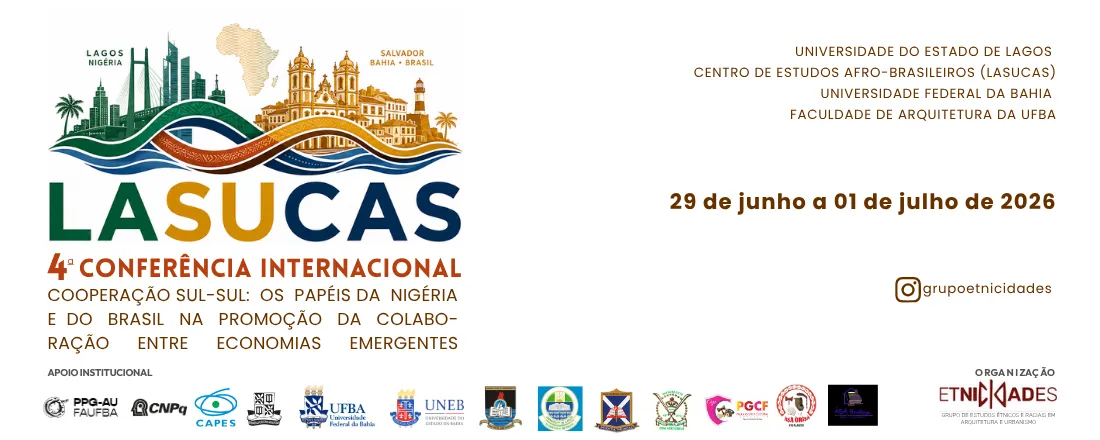
The Center for Afro-Brazilian Studies of Lagos State University (LASUCAS), Lagos, Nigeria, announces its 4th International Conference with the theme: South-South Cooperation: The Roles of Nigeria and Brazil in Fostering Collaboration Between Emerging Economies.
This conference, which will take place at the Faculty of Architecture of the Federal University of Bahia, Salvador, Brazil, from Wednesday, 27/05, to Friday, 29/05, is being organized together with the Research Group EthniCidades FAUFBA through the Graduate Program in Architecture and Urbanism (PPGAU) of the Federal University of Bahia, Salvador, and the State University of Bahia UNEB.
Nigeria and Brazil are strengthening their bilateral ties, focusing on economic growth, technological innovation and cultural exchange. Both countries reaffirmed their commitment to cooperation and mutual progress amid global change. Nigeria seeks to join the BRICS, aligning itself with Brazil's advocacy for reforms in global governance. These partnerships reflect President Bola Tinubu's efforts to diversify the Nigerian economy and strengthen global relations, especially with Brazil.
Since the signing of the Cooperation Agreement between the Federal University of Bahia, Salvador, Brazil, and the University of Lagos State in 2019, LASUCAS held its 1st conference at Lagos State University, Lagos, Nigeria in 2020, and the 2nd at the Federal University of Bahia, at FAUFBA, Salvador, in 2022. Expanding its partnership, the 3rd International Conference was held at Lagos State University, Ojo, Lagos, Nigeria, in 2024, in collaboration with the Research Group on EthniCities-FAUFBA, the Graduate Program in Architecture and Urbanism (PPGAU), Federal University of Bahia UNEB, Brazil; the Hoju Institute in Rio de Janeiro, Brazil; and the Laboratory of African Studies (Lab-I??´) of the Federal University of Rio de Janeiro, Brazil.
This 4th Conference will again be held in Brazil by three partner universities: the Lagos State University, the Federal University of Bahia and the State University of Bahia, both in Salvador, state of Bahia, Brazil.
The event will have 3 axes of approaches: 1 - Economy, Development and Sustainable Technologies in Cities; 2 - Cultural and Strategic Ties in Urban Life; 3 - Languages, Linguistics and Communication in Lived Space. These themes reflect recent developments and agreements from the meeting between President Tinubu and President Lula in Brazil, highlighting opportunities for Nigeria and Brazil to deepen their partnerships.
The Opening Ceremony of the Conference, on 27/05/2026 will be attended by several Royal Chiefs, eminent Nigerian personalities, ambassadors, institutions and corporate entities from Nigeria and Brazil.
Organizing Committee:
Prof. Tayo Ajayi – Director, LASUCAS / Coordinator in Nigeria
Prof. Fábio Velame – UFBA / Coordinator in Brazil
Prof. Sunday Bamisile – Assistant Director/LASUCAS
Profa. Any Brito Leal Ivo – UFBA – Brazil
Prof. Silvar Ribeiro – UNEB – Brazil
Prof. João Borges – UNEB – Brazil
Technical Team and Event Organizing Committee:
Msc. Oluwatoyin Zainab Sogbesan - (Ajayi Crowther University of Oyo/Nigeria)
Msc. Paula Cristina Teixeira Dias Gomes – (Cultural Ambassador of the Royal Palace of Oyo/Nigeria)
Dr. Maria Alice Pereira da Silva (Brazil)
Dr. Flávio Cardoso dos Santos Junior (Brazil)
Msc. Mário Silva Santana (Brazil)
Msc. Paula Cristina Teixeira Dias Gomes (Nigeria)
Msc. Oluwatoyin Zainab Sogbesan (Nigeria)
PhD. Titus Olatunji Adejumo (Nigeria)
Technical Team and Executive Production:
Alyne Fernanda Cardoso Reis (Brazil)
Celso Almeida (Brazil)
Gabriela Santiago Xavier (Brazil)
Iana Marucha Lopes das Virgens Santos (Brazil)
Josane Oliveira (Brazil)
Liane Monteiro (Brazil)
Luís Rogério Rosário dos Santos (Brazil)
Marianna Morena Consuelo Santos Barbosa (Brazil)
Maurício Wilson Camilo da Silva (Brazil)
Vilma Patrícia Santana (Brazil)
Rodrigo Costa (Brazil)
Sônia Mendes (Brazil)
Sueide Gonçalves Rosa (Brazil)
Thiago Assunção dos Santos (Brazil)
Valdiria Lopes das Virgens (Brazil)
HISTORY AND PREVIOUS EDITIONS OF THE LASUCAS BRAZIL/NIGERIA CONFERENCE
Since the signing of the Agreement for Technical, Scientific and Cultural Cooperation between the Federal University of Bahia - UFBA, Salvador, Brazil, and the Lagos State University – LASU through LASUCAS (Lagos State University Centre for African Studies), Lagos, Nigeria, in 2020, 3 (three) international conferences were held.
The 1st (first) conference was held at Lagos State University – LASU, Lagos, Nigeria from 03 to 07 February 2020, with the title 1st LASUCAS International Conference: Brazil in Africa / Africa in Brazil: Sharing Understandings of the Black Diaspora in the New World. Organized by the Center for Afro-Brazilian Studies (LASUCAS) of the Lagos State University, Nigeria and the Faculty of Architecture of UFBA, FAUFBA, through the Research Group EthniCities: group of ethnic-racial studies in architecture and urbanism of the Postgraduate Course in Architecture and Urbanism (PPGAU) at the Federal University of Bahia, Salvador, Brazil, from the CAPES-PRINT UFBA Program. The main objective of the Conference was to build academic ties of research, teaching and extension between Brazil and Africa, notably between the Federal University of Bahia (UFBA) and the University of the State of Lagos (LASU). The event was structured through 24 (twenty-four) thematic axes: African and Afro-Brazilian Architecture; Black Diaspora and City Production: African and Brazilian Cities in Diasporic Processes; Black Territories: black neighborhoods in Brazil, ghettos and ethnic neighborhoods in Africa and urban resistance; African and Afro-Brazilian culture and identities; Agriculture, technology and economy; African and Afro-Brazilian arts, aesthetics, fashion and beauty; Brazil-Africa trade relations; Economy and development; Food Culture and Food Distribution; Industry, Innovation and Infrastructure; Alternative health; Afro-Diasporic Literature and Orature: Black Literature in Africa and Brazil; Religions and interreligious relations in the Diaspora; Sociology of Education; Linguistics and communications; Diasporic Historicities; Drama, Music and Performance; African and Afro-Brazilian Philosophy and Pedagogy; Racism and the City: Necropolitics and Ethnic-Racial Segregation in Brazil and Africa; Sex and sexology; Science and technology; Indigenous knowledge systems; Transportation and logistics. LASUCAS website link: http://lasu.edu.ng/lasucas/index.php.
The 2nd (second) conference was held at the Faculty of Architecture of the Federal University of Bahia between November 16th and 19th, 2022, with the title 2nd. LASUCAS International Conference: Brazil-Nigeria Cooperation within the Global South, and was part of the Academic, Scientific and Cultural Cooperation Agreement between the Federal University of Bahia - UFBA and the State University of Lagos - LASU, from the Center for Afro-Brazilian Studies – LASUCAS, Nigeria, from the CAPES-Print UFBA program. The event aimed to build academic ties in undergraduate and graduate education, extension, research and innovation between UFBA and the University of the State of Lagos – LASU, between Brazil and Africa. In this bias, the event had a multidisciplinary character with the participation of researchers and professors from the areas of humanities, applied social sciences, exact sciences, biological and health sciences, engineering and technologies in the construction of South-South cooperation. South-South cooperation is a term used historically by policymakers and academics to describe the exchange of resources, technology, and knowledge between developing countries. It is a broad framework for collaboration between the countries of the South in the political, economic, social, cultural, environmental and technical domains. Involving two or more developing countries, it can occur on a bilateral, regional, sub-regional or inter-regional basis. It offers an additional and complementary pathway to renew, revitalize and multiply alternatives to sustain inclusive development and peace. Brazil and Nigeria, being members of the Global South, are increasingly contributing to global development. Therefore, the Conference focused on the contributions of the two countries, and also, how the two countries can improve relations with each other towards mutual social development. The event was structured through 24 (twenty-four) thematic axes: African and Afro-Brazilian Architecture; Black Diaspora and City Production: African and Brazilian Cities in Diasporic Processes; Black Territories: black neighborhoods in Brazil, ghettos and ethnic neighborhoods in Africa and urban resistance; African and Afro-Brazilian culture and identities; Agriculture, technology and economy; African and Afro-Brazilian arts, aesthetics, fashion and beauty; Brazil-Africa trade relations; Economy and development; Food Culture and Food Distribution; Industry, Innovation and Infrastructure; Alternative health; Afro-Diasporic Literature and Orature: Black Literature in Africa and Brazil; Religions and interreligious relations in the Diaspora; Sociology of Education; Linguistics and communications; Diasporic Historicities; Drama, Music and Performance; African and Afro-Brazilian Philosophy and Pedagogy; Racism and the City: Necropolitics and Ethnic-Racial Segregation in Brazil and Africa; Sex and sexology; Science and technology; Indigenous knowledge systems; Transportation and logistics. View website: https://cmetnicidades.wixsite.com/africa-brasil
The 3rd (third) conference was held at Lagos State University - LASU, Lagos, Nigeria between October 28-30, 2024, with the title 3rd. LASUCAS International Conference: Bridging the Atlantic: Brazil and Sub-Saharan Africa, South-South Partnership for Growth. The event was organized by the Center for Afro-Brazilian Studies LASUCAS, the Faculty of Architecture of UFBA (FAUFBA) through the research group EtniCidades, Brazil; the Hoju Institute in Rio de Janeiro, Brazil; and the Laboratory of African Studies (Lab-I??´) of the Federal University of Rio de Janeiro (UFRJ), Brazil. Transatlantic dialogues on cultural heritage began a long time ago between Brazil and Africa and continue to the present day. This conference provides a space to explore the transatlantic dialogues that consider Brazil and sub-Saharan Africa, as well as the flow of people, objects, and ideas across the Atlantic. Transatlantic Dialogues on Cultural Heritage: Heritage, Tourism and Traditions, etc. Although there is a strong historical element to the conference, the event took an interdisciplinary approach to cultural heritage, covering disciplines such as Literature, Anthropology, Afro-Brazilian Studies, Geography, Science, Technology, and even Architecture. The event was structured through the following 26 thematic axes: Brazilian arts and architecture; Racism and the city: Necropolitics and Ethnic-Racial Segregation in Brazil and Africa; Black diaspora and the production of cities: African and Brazilian cities in diasporic processes; Black Territories: black neighborhoods in Brazil, ghettos and ethnic neighborhoods in Africa and urban resistance; Religions and interfaith relations in the diaspora; Industry, innovation and infrastructure; Racial classification and black identity; Industry, innovation and infrastructure; Traditional and modern music, dance and performance in Africa and Brazil; Theater in Africa and Brazilian societies; African cuisine in the new world; Brazilian arts and architecture and their influence in Africa; Education and curriculum development of African language and culture in Brazil; Politics, society, democracy and economy; Alternative medicine, traditional medicine and modern science in Brazil and Africa; Afro-Diasporic Literature and Epistemology: Black Literature in Africa and Brazil; Linguistics, sociolinguistics, communication, and translation studies; African and Afro-Brazilian culture and identities; Ifá and the traditional religion in Brazil and Africa; In addition to trade and trade relations between Brazil and Africa; African and Afro-Brazilian Philosophy and Pedagogy; Science and Technology; Agriculture, science, technology and economy; Sociology of education, culture, economy and development; Religions and interfaith relations in Africa and the Diaspora; Patriarchy, matriarchy and gender issues in societies. See the event website: https://lasu.edu.ng/lasucas/coference/Portuguese.html
<
span style="font-size: 14px; color: rgb(0, 0, 0); background-color: transparent; font-weight: 400; font-style: normal; font-variant: normal; text-decoration: none; vertical-align: baseline; white-space: pre-wrap;" >This 4th conference with the title LASUCAS International Conference: South-South Cooperation - The Roles of Nigeria and Brazil in Promoting Urban Collaboration among Emerging Economies, will be held again in Brazil, in Salvador, during Africa Week at UFBA between 25/05/2026 and 29/05/2026, in celebration of Africa Day in Brazil, May 25, by two partner universities the Lagos State University – LASU (Nigeria), through the Center for Afro-Brazilian Studies (LASUCAS), and the Federal University of Bahia - UFBA, through the Faculty of Architecture of UFBA (FAUFBA) and the Center for Afro-Oriental Studies (CEAO). The event will be structured in three thematic axes and their respective sub-themes: Axis 1 - Economy, Development and Sustainable Technologies in Cities - Strengthening Bilateral Trade; Agricultural Collaboration; Partnerships in the Energy Sector; Cultural and Diasporic Connections; Cooperation in the Health Sector; Aviation and Connectivity; Economic Diversification and Growth; Technology and Innovation; Investment Flows: Energy and Infrastructure; Technology and Innovation; Axis 2 - Cultural and Strategic Ties in Urban Life - Cultural Diplomacy; Demographic and Economic Potential; Economic Reforms and Stability; South-South Cooperation in a Changing Global Landscape; Global Health and Development; Cultural and Urban Design Elements; Afro-Brazilian Architectural Styles; Modern Interpretations and Preservation; Contemporary Revitalization; Preservation Efforts; Biophilic Design; Cultural Syncretism; Axis 3 - Subtopics in Languages, Linguistics and Communication in Lived Space - Preservation and Language Exchange; Scholarship Opportunities; African Languages in the Brazilian Academy; Cultural and Linguistic Connections; Communication and Media Collaboration; Audiovisual Co-production Agreement; Cultural Festivals; Academic and Scientific Collaboration; Partnerships in Linguistics and Anthropology; Yoruba Studies.
 Faculdade de Arquitetura da UFBA - Salvador - Bahia - Brasil


